How a little daily movement protects your heart, brain, and mood
Your body was not made for a chair.
It was made to move.
Not extreme exercise. Not punishment. Not hours in a gym. Just movement, every single day. Walking, carrying, climbing, stretching. Using your muscles, keeping your blood flowing, waking up your heart.
For almost all of history, no one planned their movement. It was just what living took: walking to find food, carrying loads, building, farming, bending, climbing.
Your body built every one of its systems around that active life. Your heart, your lungs, your muscles, your brain, your bones, your hormones. All of them were shaped over thousands of years of moving.
Then modern life arrived. Cars, desk jobs, screens, food delivered to the door.
And almost everything changed.
The World Health Organization estimates that up to 5 million deaths a year could be avoided if people around the world were more active. Too little movement is now one of the leading causes of early death.
And almost all of it can be prevented.
Picture two people, both 40 years old. Same health. Same job. Both sit at a desk most of the working day.
The first person never adds any movement on purpose. Drives everywhere. Takes the elevator. Spends evenings on the sofa.
By 60, stairs are a struggle. Blood pressure is up. There is medication for blood sugar. Getting out of a chair takes real effort.
The second person walks every morning. Stands up often during the day. Takes the stairs. Stretches in the evening. Does a few simple strength exercises twice a week.
Nothing extreme. Just steady, daily movement.
By 60, the second person still walks with ease, with a strong heart, normal blood sugar, and energy and clear thinking mostly still there.
Same starting point. Same genes. Twenty years of different daily choices.
Two completely different bodies.
Your body keeps a record. Not on paper, but in your tissues, your blood vessels, your heart, and your brain.
Every day adds something. The only question is what.
Daily movement is not just about burning off food. That is the most common, and most limiting, way to think about it.
When you move, you are telling your body something. Keep this. Strengthen this. Keep this working.
When you stop moving, the message changes. This is not needed anymore. Let it fade.
And the body listens. Muscles weaken, because nothing is telling them to stay strong. Bones lose strength, because nothing is loading them. Blood vessels stiffen, because they are never fully used.
The brain gets less blood and fewer growth signals. Your body’s handling of food and energy slows down. Your immune system loses its edge.
None of this happens fast or all at once. But it happens, steadily, over months and years, until one day the change is too big to ignore.
Daily movement keeps you off that path.
Your heart is a muscle. And like every muscle, it gets stronger with healthy work.
When you move, your heart beats faster, your blood flows better, and more oxygen reaches your organs.
Over time, your heart adapts. It grows stronger. It works more smoothly. It pushes more blood with every beat, so it can do less work when you are at rest.
This is why fit people have a slower resting heartbeat. Their hearts have grown used to regular work.
The American Heart Association strongly recommends regular activity to protect your heart and lower your risk of heart disease, the single biggest cause of death in the world.
A large study of more than 120,000 adults, published in JAMA Network Open, found that fitness was one of the strongest signs of how long a person would live. The least-fit people had several times the risk of dying in the following years compared with the fittest. Being unfit carried a risk on a par with smoking or diabetes.
And here is the encouraging part.
The single biggest gain in survival came simply from leaving the least-fit group.
You do not have to become an athlete. You just have to stop being completely still.
Movement does not only help your body. It helps your brain too. A lot.
When you move, blood flow to your brain rises straight away, and more oxygen and fuel reach it.
Movement also triggers a protein called BDNF.
Think of BDNF as fertilizer for the brain. It helps new brain cells grow, and it strengthens the links between the ones you already have. Your body makes the most of it during steady aerobic activity, the kind that gets you a little out of breath, like brisk walking.
This growth happens most in the part of the brain that handles memory and learning. Regular aerobic exercise actually increases the size of that part of the brain. It slows the natural shrinking that happens there with age, and that directly protects your memory.
The CDC confirms that physical activity improves brain health, thinking, learning, memory, sleep, and mood, at every age.
Have you ever noticed that after sitting too long, your mind feels slow? Foggy?
Then you stand up, walk, take a few deep breaths. And your thinking clears.
That is not your imagination. That is your brain responding to movement, then and there.
A short walk can change how you feel. That is not a motivational slogan. It is biology.
Exercise lowers cortisol, your body’s main stress hormone. When cortisol stays high for too long, it wears down your brain and body. Exercise brings it down.
Exercise raises serotonin and dopamine, two of the brain’s feel-good messengers. Serotonin is tied to steady mood. Dopamine is tied to motivation and reward.
Exercise also releases endorphins, the body’s own natural mood-lifters. They are behind the well-known lift many people feel after moving.
A study that pooled nearly 50 earlier studies, published in the American Journal of Psychiatry, found that more active people had a meaningfully lower chance of developing depression than inactive people. A pooled study like this combines the results of many studies to give a clearer, more reliable picture.
This held true across countries, ages, and both sexes.
Movement is one of the most powerful mood boosters available to anyone. Anywhere. For free.
Movement is not only about burning off food. Your muscles are where most of your blood sugar gets used up.
Blood sugar, also called glucose, is the main fuel your body runs on.
When your muscles work during movement, they pull glucose out of your blood. And they can do this without needing insulin. Insulin is the hormone that normally tells your cells to take in blood sugar.
So movement helps steady your blood sugar even in people whose insulin is not working as well as it should.
A 10-minute walk after eating has been shown to lower the blood sugar spike from that meal, compared with sitting still. It is one of the simplest and most effective things you can do for your blood sugar, and it needs no equipment.
And with regular exercise over weeks and months, your muscle cells get even better at taking in glucose. The tiny power stations inside your cells, called mitochondria, multiply, so your body makes energy more efficiently.
The risk of type 2 diabetes drops a lot.
The American Diabetes Association confirms that both aerobic exercise and strength exercise meaningfully improve blood sugar control, in people with and without diabetes.
Here is something most people do not know. Sitting too much is a health risk all on its own. That means it can harm you separately from whether you exercise at other times.
Research published in the Annals of Internal Medicine found that adults who sit for more than eight hours a day have a higher risk of heart disease, type 2 diabetes, and early death. Being active lowers this risk, but for people who sit that much, one daily workout does not fully erase it.
So someone who exercises for an hour and then sits for the rest of the day is in a different position from someone who exercises for an hour and also keeps moving through the day.
Why?
Because long, unbroken sitting drops your muscle activity to almost nothing.
This switches off an enzyme called lipoprotein lipase. An enzyme is a tiny worker protein that drives a chemical job in your body. This one helps break down fat for energy. When it switches off, fat-burning largely stops.
Within about 90 minutes of unbroken sitting, your body’s handling of fat and sugar is already measurably worse.
The American Heart Association specifically warns about the dangers of too much sitting.
So what can you do? It is simple.
Here is the most important thing to understand about movement and health.
The biggest health gains do not come from going from fit to super-fit. They come from going from doing nothing to doing a little.
The first steps give the biggest reward.
The same large study in JAMA Network Open found that the single biggest drop in the risk of early death came from moving out of the least-fit group, not from reaching the very top.
You do not need to run a marathon. You do not need a gym membership. You do not need costly equipment or a complicated plan.
You just need to stop being completely still.
A daily walk is powerful medicine. Taking the stairs counts. Walking to nearby places counts. Stretching in the morning counts. Playing with children counts. Gardening counts. Dancing counts.
The WHO recommends at least 150 minutes of moderate activity a week, the kind that gets you a little out of breath, plus muscle-strengthening activity at least twice a week.
That is 30 minutes a day, five days a week. Within reach for almost everyone, even starting from nothing.
The movement that works best is the kind that becomes a fixed part of your day.
Not something you do when you feel motivated. Something that happens whether you feel like it or not. Like brushing your teeth.
Here is how to build it.
Even 15 to 20 minutes. Before work, after waking, or on a break. Morning movement sets a good tone for the whole day, and locks in the habit before the day finds reasons to skip it.
Every time. No exceptions. This small daily choice adds up to thousands of extra bits of movement over a year.
Set a reminder if you need one. Stand for two minutes. Walk a little. Sit back down. This breaks up the harm that long sitting does.
Even a 10-minute walk after eating lowers your blood sugar spike and helps digestion. It is one of the best-proven, lowest-effort things you can do for your health.
You do not need a gym. Chair squats, wall push-ups, resistance bands, or climbing stairs with a loaded backpack. Simple moves that work your main muscles, twice a week, 15 to 20 minutes each.
Walk with a friend. Join a class. Play a sport. Take phone calls on a walk. When movement is shared, you stick with it far more easily, and you enjoy it more.
Enjoyment is the strongest sign that someone will keep exercising for the long run. It beats discipline, guilt, or knowing the health facts. Pick movement you look forward to, and build from there.
This plan assumes you are starting from little or no regular movement.
Monday: Walk 20 minutes.
Tuesday: 15 minutes of simple strength exercises. Chair squats, wall push-ups, resistance bands.
Wednesday: Walk 25 minutes. Stand up every hour through the day.
Thursday: Gentle stretching for 10 minutes. Walk for 15 minutes.
Friday: Walk 30 minutes.
Saturday: 20 minutes of strength exercises.
Sunday: A relaxed, gentle walk. 15 minutes.
Simple. Repeatable. Realistic. That matters more than a burst of motivation.
Start here. Add five minutes to each session each week.
Within four to six weeks, the habit will be set. Within eight to twelve weeks, your body will have started to change.
Your energy will be higher. Your mood steadier. Your sleep often better. Your blood sugar more even.
The changes are real. And they start within days of moving regularly.
The World Health Organization recommends at least 150 to 300 minutes of moderate activity a week, plus muscle-strengthening activity at least twice a week. That is about 30 minutes of moderate movement, five days a week. These are evidence-based minimums, and the benefits keep growing beyond them. But the most important step is simply to start.
Walking is an excellent foundation and real medicine for your health. Brisk walking counts as moderate activity and brings genuine benefits for your heart, your blood sugar, and your mind. For fuller protection, add some strength exercise twice a week, since that builds the muscle and bone strength that walking alone does not quite keep up.
Most people have more time than they think, once movement is built into the day rather than added on top of it. Walking on a break, taking the stairs, standing up every hour, and walking after dinner all use time that is already there. The World Health Organization points to at least 150 minutes a week, which is about 21 minutes a day.
Yes. A pooled analysis in the American Journal of Psychiatry found that more active people had a meaningfully lower risk of developing depression than inactive people. The reasons are direct: exercise lowers the stress hormone cortisol, raises the feel-good messengers serotonin and dopamine, releases natural mood-lifting endorphins, and helps grow new brain cells in areas tied to mood.
Long, unbroken sitting drops your muscle activity to almost nothing, switches off fat-burning, and worsens blood sugar control. Research in the Annals of Internal Medicine found a higher risk of heart disease and early death in people who sit more than eight hours a day. Being active lowers that risk, but for heavy sitters it does not vanish. Breaking up your sitting every 30 to 60 minutes with a little movement helps a lot.
Walking. It is free, easy to do, needs no equipment, and carries little risk of injury. The American Heart Association recommends starting with brisk walking and slowly building up. Add a few simple bodyweight strength exercises twice a week from the start, to protect your muscle and bone strength.
Absolutely. Walking, bodyweight exercises, resistance bands, stair climbing, cycling, and sports all meet the need for both aerobic and strength work. The WHO guidelines say nothing about needing a gym. The best place to exercise is wherever puts the fewest barriers between you and moving regularly.
Want to understand the full science behind moving well? Read these pillar guides.
The full science of movement, fitness, and keeping your body strong for life.
How movement steadies your blood sugar and protects your energy.
How movement lifts your mood, sharpens your mind, and protects your brain.
What deep sleep does for your brain and body, and how to get more of it
Most people think of sleep as an empty space. A pause. A gap between the things that really matter.
This is one of the biggest mistakes we make about our health.
Sleep is not a switching-off. It is one of the busiest times your body ever has. More is going on inside you during a good night’s sleep than during almost any other eight hours of your life.
Your brain is filing away the day’s memories for keeping. It is also being washed clean, by a system that only works properly while you sleep.
Your immune system, the part of you that fights off illness, is tuning itself up. Your muscles are repairing the tiny bits of damage from the day.
Your hormones are resetting, with a repair hormone being released. Your cells are renewing themselves. The feelings from your day are being sorted and settled.
Almost none of this happens while you are awake. It happens in sleep. And not just any sleep.
Deep sleep. The kind most people are not getting enough of.
Sleep experts worldwide point to seven to nine hours a night for most adults. But the number of hours is only part of the story. How deep those hours go matters just as much.
Picture a busy building.
All day, work goes on inside it, and waste builds up as it does. Paper, wrappers, empty cups. The mess piles up through the day.
At night, a cleaning crew moves through. They clear it all away and leave the building fresh and ready for morning.
Now picture that cleaning crew being locked out. Night after night.
The building never gets a proper clean. The waste piles higher. The hallways get harder to move through.
Things start to break down.
This is close to what happens to your brain when you keep missing out on deep sleep.
Your brain has its own nightly cleaning system. Doctors call it the glymphatic system, but you can just think of it as the brain’s waste-clearing system. While you sleep, it washes away the leftover waste your brain made during the day.
Some of that waste is two sticky proteins called amyloid-beta and tau. These are the same proteins that build up in the brains of people with Alzheimer’s disease, and over many years a build-up of them can damage how the brain works.
Research published in Science found that during sleep, the space between your brain cells opens up by about 60 percent. That extra room lets fluid flow through more freely and rinse the waste away.
In that study, the brain cleared amyloid-beta about twice as fast during sleep as it did while awake.
Brain-scan studies in people have even shown that a single night without sleep leaves more of this waste protein behind. A single night.
Without it, the mess builds up. Slowly. Quietly.
Sleep is not one steady state. It comes in cycles, each lasting about 90 minutes. Each cycle moves through different stages, and each stage does a different job inside you.
Across a full night, most people go through four to six of these cycles. Getting through the whole sequence, again and again, is what makes sleep restoring. Cutting it short throws off the sequence, and it strips away the most valuable stages first.
This is the drift from awake to asleep. It lasts only a few minutes. Your muscles loosen, your breathing slows, and your brain begins to change gear.
This stage is easily broken. A sound, a light, a worried thought, a buzz from your phone, any of these can pull you back awake.
This is where you spend the most time over the whole night. Your body cools a little and your heart slows.
Your brain sends out quick bursts of activity called sleep spindles. These bursts help lock the day’s learning into memory, and help block out noises that might otherwise wake you.
This is the most restoring stage of all.
Your brain produces big, slow waves, the slowest of your whole day.
Your repair hormone is released mostly now. Your blood pressure falls to its lowest point of the day. Your immune system and your brain’s cleaning system are both at their busiest. Your muscles repair, and your cells renew.
This is the stage most people are short of.
And here is the catch: deep sleep happens mostly in the first half of the night. Going to bed late steals it. Even if your total hours look fine, a late bedtime quietly cuts your deep sleep down.
REM stands for Rapid Eye Movement. In this stage your brain is almost as busy as when you are awake, and your eyes flick about beneath closed lids.
Most dreaming happens here. So does the sorting of feelings, and creative thinking and problem-solving.
Something interesting happens during REM: a stress chemical in the brain, called norepinephrine, switches off.
With that stress chemical gone, the brain can replay the day’s upsetting moments and file them away, while taking the sharp emotional sting out of them. This is why a problem that feels huge at midnight often feels smaller by morning.
REM sleep mostly comes in the last hours of the night. So cutting your sleep short by even an hour or two robs you of a big share of it.
Deep sleep is the most physically restoring time in your whole day and night.
More of your repair hormone is released during a single night of deep sleep than at almost any other time.
This repair hormone is made by a small gland at the base of your brain. It drives the repair of tissue, the recovery of muscle, the upkeep of your bones, the burning of fat, and the renewal of cells.
Deep sleep is when your muscles mend the tiny wear and tear from the day. It is when your immune system works hardest.
It is when your brain does its deepest cleaning. And it is when your blood pressure drops to its lowest, giving your heart and blood vessels their one real rest of the day.
The amount of deep sleep you get naturally falls as you age. Children and teenagers get far more of it than adults, and by middle age it is much less than in your twenties.
This is one reason recovery, immune strength, and sharp thinking all fade a little as people grow older.
The habits that protect deep sleep are the same habits that protect your whole body: a steady sleep schedule, a cool bedroom, less alcohol, no late caffeine, and regular exercise.
REM sleep is where the mind does its most important tidying. It is where memories are sorted, filtered, and filed.
It is where the feelings from your day are processed and their sting reduced. And it is where the brain links up ideas in new, creative ways.
Research published in Current Biology found that after a sleepless night, the brain’s alarm center reacted about 60 percent more strongly to upsetting images than it did in well-rested people. That alarm center is a small part of the brain that drives fear and strong feelings.
This is why everything feels harder, sharper, and more threatening after a bad night. It is not just tiredness. It is your brain trying to handle feelings without having had its overnight repair.
That switched-off stress chemical during REM is what makes this repair possible. You cannot copy it while awake. No amount of meditation, exercise, or talking does quite the same thing for the brain.
REM sleep cannot be replaced. And it is the first thing you lose when you cut sleep short.
The discovery of the brain’s cleaning system changed how scientists understand sleep.
For most of history, doctors knew sleep mattered. But they did not understand why the brain needed it so badly. A big part of the answer was published in Science in 2013.
During sleep, especially deep sleep, the cells around the brain’s blood vessels shrink. This opens up channels, and through these channels flows the clear fluid that cushions your brain and spine.
As the fluid flows, it rinses out the waste that built up during the day’s thinking.
The most important bits of that waste are the two proteins, amyloid-beta and tau, the same ones found in the brains of people with Alzheimer’s disease. The cleaning system washes both away during sleep. When you do not sleep enough, that washing is left unfinished.
There is also a longer-term link worth knowing about, told honestly.
Large studies that follow people for many years have found that those who regularly sleep six hours or less in their 50s and 60s are more likely to develop dementia later on.
One study that followed nearly 8,000 people for 25 years found that steady short sleep was tied to about a 30 percent higher risk of dementia, as reported in Nature Communications.
Scientists are careful here. This does not prove that short sleep causes dementia. It is also possible that the very early, hidden stages of the disease are what disturb the sleep.
But the link keeps showing up, and protecting your sleep is one sensible way to look after your brain for the long run.
The single biggest burst of your repair hormone in the whole day comes during the first stretch of deep sleep at night. It drives tissue repair, muscle recovery, bone upkeep, and fat burning.
This nightly rest for your heart and blood vessels is essential. When you miss deep sleep, your blood pressure does not fall the way it should overnight, and your heart never fully recovers from the day. The American Heart Association names poor sleep as a risk factor for heart disease in its own right.
During deep sleep, your body makes more of the proteins that direct your immune cells, telling them where to go and what to do. Without enough sleep, this gets muddled.
Research published in Sleep found that people sleeping fewer than six hours were more than four times as likely to catch a cold after being exposed to the virus.
Special repair cells that mend your muscle fibers are at their busiest during deep sleep. Exercise only helps you because of the repair that happens during rest. Without deep sleep, that repair is left half-done.
The part of your brain that handles new memories replays the day during deep sleep and passes those memories to another part for long-term keeping.
Deep sleep is very fussy about timing. It is packed into the first half of the night, roughly the first four hours after you fall asleep. Going to bed later squeezes that window.
Think of two nights with the same number of hours in bed. On the first, you go to bed at midnight and sleep until 8am. On the second, you go to bed at 10pm and sleep until 6am. Both are eight hours.
But the midnight night gives you less deep sleep and more of the lighter stages. The number of hours is the same. The quality is not.
This is why when you sleep matters as much as how long you sleep.
Alcohol knocks you out, but it does not give you real, natural sleep. It cuts your deep sleep in the second half of the night.
People who drink before bed tend to get less deep sleep and less REM, even when their total hours look fine. They wake up less rested no matter how long they were in bed.
Caffeine sticks around in your body for a long time. It takes roughly five to seven hours just to clear half of it, so a coffee at 3pm still has about half its caffeine working in you at 8pm.
This does not only make it harder to fall asleep. It also quietly lowers the amount of deep sleep you get, even if you drop off easily.
Your body has to cool down a little to fall into deep sleep and stay there, and a bedroom that is too warm blocks that cooling.
Research points to a bedroom temperature of about 16 to 18 degrees Celsius (60 to 65 Fahrenheit) for the best deep sleep. That is cooler than most people keep their rooms.
Your body runs on an internal 24-hour clock. When your sleep and wake times jump around, that clock cannot settle, and your deep sleep suffers. Keeping the same wake time every day is the strongest anchor for good deep sleep.
When you are stressed for a long time, your body keeps the stress hormone cortisol high. High cortisol pushes down deep sleep in particular. This is a big reason stressed people wake up tired no matter how long they slept.
The blue light from screens holds back melatonin, the hormone that tells your body that night has come and it is time to sleep. Less melatonin means it takes longer to drop off.
But there is more to it: the news, the messages, the scrolling all switch your brain on. And a switched-on brain cannot slide easily into the slow waves of deep sleep.
Deep sleep is locked to the first half of the night. Going to bed at 10pm instead of midnight gives you more of it, whatever time you wake up.
Pick a wake time you can keep seven days a week. Set it, and stick to it. This one habit steadies your body clock faster and more powerfully than anything else. Everything else builds on it.
Most people keep their bedroom too warm for good deep sleep. Aim for about 16 to 18 degrees Celsius (60 to 65 Fahrenheit).
A warm bath or shower 60 to 90 minutes before bed actually helps, because it pulls heat to your skin and lets your core cool down afterward, which nudges you into deep sleep.
No caffeine after 1pm. If your sleep is poor, try moving that to noon for two weeks and see what changes.
Even one or two drinks measurably cuts your deep sleep. For most adults, this is the single most powerful change you can make for sleep quality.
The National Sleep Foundation finds that regular exercisers report better sleep than people who do not exercise. Morning or afternoon is the best time for hard exercise. A tough workout within two hours of bed can keep some people up, by warming the body and raising stress hormones.
Your body cannot jump from full alert straight into deep sleep. In the 30 to 60 minutes before bed, dim the lights, put the screens away, and do something genuinely calm. Read a real book. Stretch gently. Try slow breathing.
Step outside within 30 minutes of waking, even on a grey day. Morning light sets your body clock, which in turn sets the timing of the hormones that decide when your deep sleep comes that night.
Ten to fifteen minutes of outdoor morning light is one of the most powerful and most ignored sleep tools there is.
Deep sleep is the third stage of the sleep cycle, also called slow-wave sleep. During it, your brain produces big, slow waves, the slowest of your day, which go with the deepest rest. Your repair hormone is released mostly during deep sleep. Your brain’s cleaning system is at its busiest, your immune system works hardest, and your blood pressure falls to its lowest point of the day. It is the most physically restoring part of sleep, and it is packed into the first half of the night.
Most adults need roughly 1.5 to 2 hours of deep sleep a night, which is about 15 to 25 percent of total sleep. The amount naturally drops as you age. To protect it, get enough total sleep, keep steady sleep and wake times, go to bed earlier, keep your bedroom cool, and avoid alcohol and late caffeine.
Too little deep sleep harms your physical recovery, your immune system, your hormones, and your blood sugar control. Less repair hormone is released, your immune cells are slower to act, your brain’s waste-cleaning is left unfinished, and your blood pressure does not recover properly overnight. You wake up tired even after enough hours. Over time, too little deep sleep is linked to a higher risk of obesity, type 2 diabetes, heart disease, and brain disease.
No. Alcohol makes you drowsy, which is why people fall asleep faster after drinking, but the sleep it gives is worse. Alcohol cuts your deep sleep and your REM sleep, and the second half of the night becomes lighter, more broken, and less restoring. People who drink before bed score worse on objective measures of sleep quality. The feeling that a nightcap helps you sleep is not backed up by what is actually happening in the body.
Waking in the second half of the night is common. There are a few usual causes. Alcohol in the evening, which disturbs the later part of your sleep. Caffeine taken too late in the day. High stress, which keeps cortisol up just as it naturally starts rising toward morning. A bedroom that is too warm. And a heavy, starchy evening meal that sends your blood sugar up and down.
It is your brain’s waste-removal system. During sleep, the cells around your brain’s blood vessels shrink, opening channels for the clear fluid that cushions your brain to flow through and rinse out waste. The most important waste it clears is the two proteins, amyloid-beta and tau, both found in the brains of people with Alzheimer’s disease. Research in Science found that during sleep the space between brain cells opens by about 60 percent, which speeds this cleaning, clearing amyloid-beta about twice as fast as when awake.
Your body has to lower its core temperature a little to fall into and hold deep sleep, so a bedroom that is too warm stops this cooling and gives you shallower sleep. Research points to about 16 to 18 degrees Celsius (60 to 65 Fahrenheit) for most adults. A warm bath or shower 60 to 90 minutes before bed helps in a way that seems backward: it draws heat out to your skin, so your core cools down afterward, which speeds you into sleep.
Want to understand the full science behind your rest? Read these pillar guides.
The complete science of sleep, recovery, and why protecting it protects everything else.
How sleep shapes memory, mood, focus, and long-term brain health.
The habits that protect your brain and body across a long life.
A simple, visual way to eat well at every meal, whatever your budget
Most people know they should eat better. Very few know exactly what that means.
The internet is full of advice that argues with itself. Eat less carbs. No, eat less fat. Count your calories. No, forget calories and just eat good food. Never touch red meat. No, you need more protein.
It is tiring. It is confusing. And most of it misses the point.
Because eating well does not need a complicated system. You do not have to weigh every gram. You do not have to give up whole groups of food. You just need one simple idea, and to use it at every meal.
The idea is called the balanced plate. Almost no other idea about food has more science behind it.
Health authorities around the world, including the World Health Organization, describe a healthy plate in a single picture, built from decades of research. It tells you clearly how much of each kind of food to put on your plate.
This article shows you how to build one at every meal. Without a degree in nutrition. Without costly supplements. Without giving up food you love.
Picture two lunches, both eaten by people who think they are eating reasonably well.
The first person has a big bowl of pasta with tomato sauce, a slice of garlic bread, and a glass of fruit juice.
The second person has a piece of grilled fish with sweet potato, a big pile of leafy greens and tomatoes, and a little olive oil drizzled on top.
Both feel like normal lunches. Both are eaten on a normal day.
But what happens inside the body in the two hours after each one is completely different.
The first lunch is almost all white starch and sugar. The blood sugar shoots up, then it crashes. A couple of hours later comes the fight to stay awake, the craving for something sweet, and the struggle to focus.
The second lunch gives steady energy, from the good fat and the protein. And the carbohydrate in the sweet potato lets its sugar out slowly, because of the fiber it still has in it.
Fiber is the part of plant food your body cannot break down, and it slows everything down in a good way. So the second person stays sharp all afternoon, and does not feel hungry again until the evening.
Same time of day. Same good intentions. Two completely different results inside the body.
Building a balanced plate is about understanding that difference, and choosing the second plate, again and again.
A balanced plate is not a strict rule. It is just a way of thinking about how much of each kind of food goes on your plate.
At its heart, a balanced plate brings together four things. Something that gives you protein. Lots of vegetables, in plenty of different kinds. Some carbohydrate from a whole food. And a little healthy fat.
Put together, these four things give your body the nutrients it needs. They also keep your blood sugar steady, keep you full for hours, and give you energy that lasts. You get none of the spike and crash that comes from a meal that is mostly starch.
The World Health Organization says a healthy diet is full of fruit and vegetables, beans and lentils, whole grains, and nuts, with only a little salt, sugar, and saturated fat. Saturated fat is the kind that is mostly solid at room temperature, like the fat in butter and fatty meat.
The balanced plate is just a simple way to put that advice on your table at every meal.
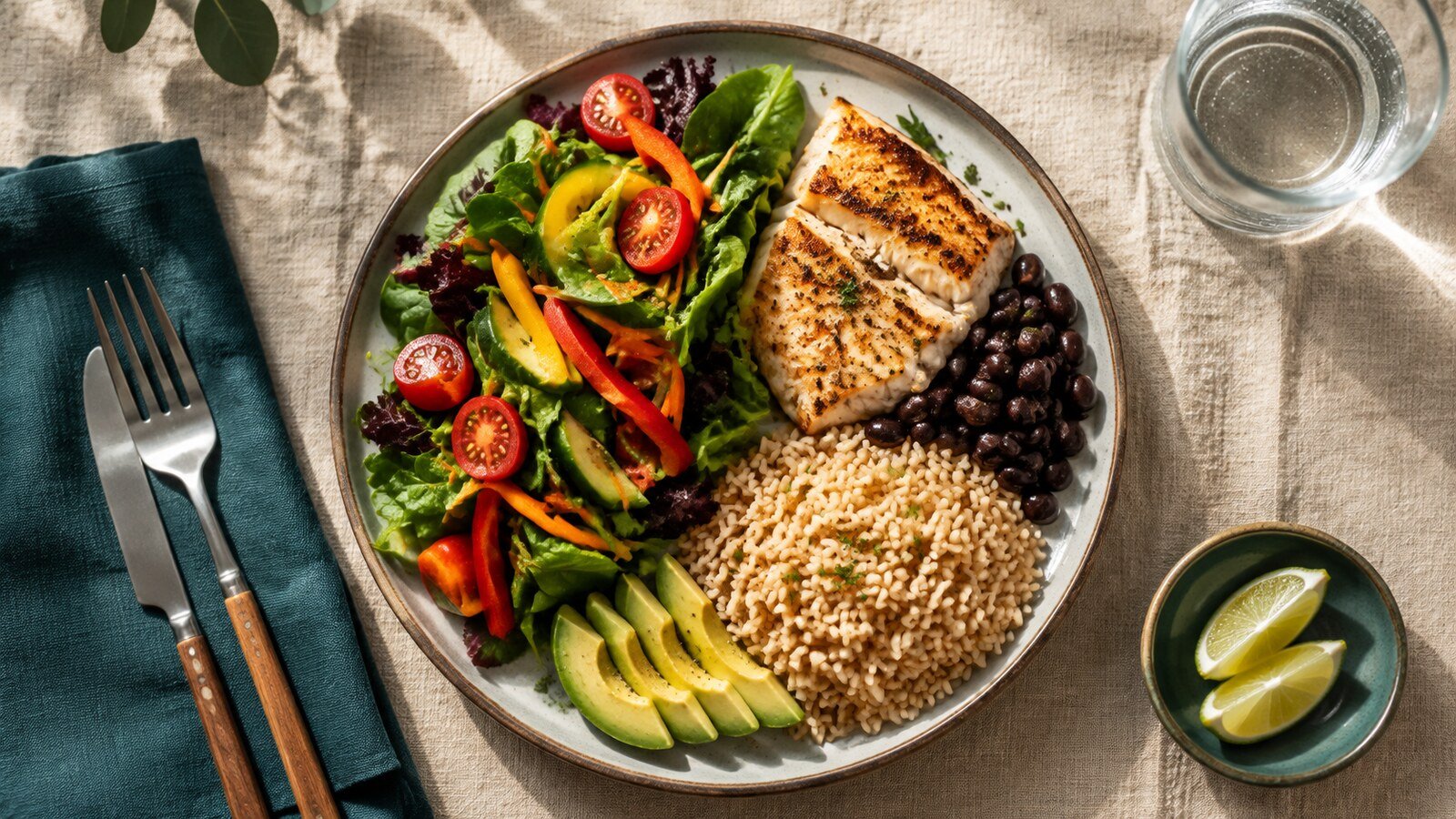
Here is the whole idea in a picture. Imagine your plate split into parts.
Different colors, different kinds. Raw or cooked. Fresh or frozen. They all count. The goal is plenty, and lots of variety. The more different vegetables you eat across the week, the better.
Eggs, chicken, fish, lean meat, plain yogurt, lentils, chickpeas, tofu, or beans. About the size of your palm. Enough to give you 25 to 40 grams of protein in the meal.
Brown rice, sweet potato, maize, whole-grain bread, oats, or millet. Not white rice, white bread, or instant oats. Whole grain just means the grain still has its fiber, vitamins, and minerals in it.
Olive oil for cooking. A little avocado. A handful of nuts or seeds. The fat from oily fish. This does not really take up room on the plate. It goes into the meal as you cook it.
That is the whole framework. Four parts, at every meal, with no calorie counting needed.
The World Cancer Research Fund confirms that eating this way, built around whole grains, vegetables, fruit, and beans, is linked to a lower risk of several cancers, and is supported by evidence on heart health and type 2 diabetes too.
Protein is the most important part of a balanced plate.
It is one of the three big nutrients your body needs in large amounts. The three are protein, carbohydrate, and fat. Protein does things the other two cannot.
It keeps you full longer than carbohydrate or fat. Your body even burns a little energy just digesting it.
It builds and keeps up your muscle at every age. It steadies your blood sugar better than anything else on the plate. And it slows the gradual muscle loss that makes people weaker and frailer as they get older.
Health authorities such as the World Health Organization point to a mix of protein sources, leaning on beans, lentils, fish, eggs, and lean meat, and changing them up through the week.
Oily fish deserve a special mention. That means fish like salmon, mackerel, sardines, and herring. They give you protein and a special kind of fat called omega-3.
Omega-3 is a fat your body needs but can only make in tiny amounts, so you have to get it from food. The kind in oily fish is the kind your body absorbs and uses most easily. (Doctors call these two forms EPA and DHA.)
It is linked to a healthy heart, a healthy brain, and less inflammation. Inflammation is the swelling and irritation the body uses to fight trouble, but it harms you when it stays switched on too long.
Try to eat oily fish at least twice a week. If you do not eat fish, walnuts, flaxseeds, and chia seeds give you a plant form of omega-3.
This is the part of the plate most people short-change.
Vegetables need to fill half the plate. Not a garnish. Not a few leaves on the side.
Why? Because vegetables pack in more fiber, vitamins, minerals, and protective plant compounds than almost anything else you can eat.
Fiber, again, is the part of plants your body cannot break down. It slows your blood sugar, feeds the good bacteria in your gut, and keeps you full between meals.
Those protective plant compounds have a name: phytonutrients. They calm inflammation and protect your cells from damage. Different colored vegetables hold different ones, so eating lots of different colors across the week gives you lots of different kinds of protection.
The Global Burden of Disease Study, published in The Lancet, found that eating too few vegetables, too few whole grains, and too little fruit is among the leading food-related causes of early, preventable death in the world.
This does not mean living on salad. It just means eating enough plants at every meal to give your body what it needs. Roasted, steamed, stir-fried, or made into soups, it all works. How you cook them matters far less than how many, and how many different kinds.
These trillions of tiny helpful bacteria living in your gut have a name: the microbiome. More variety on your plate means a richer mix of these helpful bacteria, and a richer mix means a stronger immune system, better blood sugar control, and even better mood.
The American Gut Project found that people who ate 30 or more different plant foods a week had noticeably more diverse, healthier guts than people who ate 10 or fewer.
Carbohydrates are not the enemy. The problem is the stripped-down ones.
This difference matters more than almost anything.
A bowl of oats and a bowl of sugary cereal are both carbohydrates, but they behave completely differently inside you.
Oats keep their fiber and their goodness. Their sugar comes out slowly and steadily, your blood sugar rises gently, and your energy lasts.
Sugary cereal has had its fiber and goodness stripped out in the factory. Its sugar floods your blood fast, your blood sugar spikes, and then it crashes.
The rule is simple. Choose the whole grain version of everything. Brown rice instead of white. Whole-grain bread instead of white bread. Oats instead of sweet cereal. Whole-grain pasta instead of the usual kind.
The fiber is what makes all the difference. It slows digestion down, softens the rise in blood sugar, feeds your gut, and keeps you full between meals.
A major review commissioned by the World Health Organization, published in The Lancet, found that people who eat the most fiber and whole grains have clearly lower rates of heart disease, type 2 diabetes, and bowel cancer.
This is not about eating less carbohydrate. It is about choosing carbohydrate that still has its fiber in it.
Eating fat does not make you fat. That idea came from shaky science decades ago, and later research has shown it was wrong.
Your body needs fat. It uses fat to build important hormones, like testosterone and estrogen, and without enough fat the body cannot make them properly. Your brain is about 60 percent fat.
And some vitamins can only get into your body when there is fat alongside them. These are vitamins A, D, E, and K. No fat in the meal means your body cannot take them in.
So eating vegetables with no fat at all means you absorb far less of their goodness.
Which means the olive oil on your salad is not a treat you should feel guilty about.
Your body needs it there.
The healthiest fats come from extra virgin olive oil, avocados, nuts, seeds, and oily fish. The American Heart Association recommends swapping saturated and trans fats for healthier fats from plants and oily fish.
Trans fats are factory-made fats found in some processed and fried foods. They raise your risk of heart trouble, and they are best avoided altogether. Saturated fat, found in things like processed meat, is fine in small amounts but worth keeping low.
But the fats from olive oil, avocado, nuts, and oily fish are good for you, full stop.
Here is what a balanced plate looks like in real life.
Half the plate: A generous heap of roasted or steamed vegetables, such as broccoli, peppers, and tomatoes.
A quarter of the plate: A palm-sized piece of fish or chicken, or a cup of cooked lentils or beans.
A quarter of the plate: Half a sweet potato, or a cup of brown rice, or two slices of whole-grain bread.
The fat: A drizzle of olive oil over the vegetables, or a quarter of an avocado on the side.
That is it. No weighing. No tracking. No hard sums. Just four parts, built into every meal, again and again.
This is not a diet. It is simply a way of eating. A pattern.
The nutrition change that lasts is the one that turns into a habit. And a habit forms when you do something often enough that it becomes automatic. So start with one meal a day built this way. Then two. Then every meal.
Two eggs with a handful of greens and a few tomatoes, with a slice of whole-grain bread and half an avocado.
Or: Plain yogurt with a handful of fruit, a spoon of mixed seeds, and a little oats.
Or: Beans on whole-grain bread with sliced tomato and a squeeze of lemon.
All three give you protein, vegetables or fruit, whole grain, and healthy fat, all at once.
A big salad of mixed leaves, cucumber, onion, and tomatoes, with a tin of sardines, dressed with olive oil and lemon.
Or: Lentil soup with a chunk of whole-grain bread and a simple green salad.
Or: Brown rice with grilled chicken, stir-fried vegetables, and a little oil.
Baked fish with sweet potato and steamed vegetables.
Or: Chickpea and vegetable stew with brown rice.
Or: Lean meat with a big helping of roasted vegetables and a green salad.
Every one of these follows the same idea. Something from each of the four parts of the plate. Every time.
A breakfast that is all carbohydrate sets up a rocky blood sugar pattern for the whole day. Adding 25 to 30 grams of protein at breakfast steadies your energy and cuts your cravings for hours.
Most people think they eat more protein than they really do. A palm-sized portion is the least you want at each main meal. Less than that, and your body is short on what it needs for muscle, steady blood sugar, and feeling full.
Vegetables are the foundation of the plate, not a decoration on the side. Half the plate, every meal. This one change alone improves your gut, your immune system, and your overall health.
Low-fat processed foods almost always swap the fat for more sugar, more refined starch, or more additives. Plain full-fat yogurt, whole eggs, avocado, nuts, and olive oil all beat their low-fat processed versions.
Sweet drinks, fruit juice included, pour sugar into your blood with no fiber to slow it down. They spike your blood sugar and add energy that does not even leave you full. Swap them for water, plain tea, or black coffee.
The gap between white bread and whole-grain bread is not small. It is big. The same is true for rice, pasta, and every other grain. Choose the whole grain version, every time.
The simplest way is to make one change at every meal: add a palm-sized portion of protein, fill half the plate with vegetables, and choose a whole grain version of the carbohydrate. Do those three things at every meal, and the quality of your food will change within weeks. The balanced plate, described by the World Health Organization and health authorities worldwide, gives you a simple picture to follow.
Most adults need about 25 to 40 grams of protein at a meal to feel properly full, keep their blood sugar steady, and build and repair muscle. A palm-sized portion of most protein foods gives you roughly that. Spreading your protein across the day, rather than eating most of it in one go, is better for keeping up your muscle.
Whole fruit is healthy, but fruit juice is not the same thing. Juicing throws away the fiber and leaves you with concentrated sugar, so a glass of juice raises your blood sugar almost as fast as soda. A glass of orange juice has about the same sugar as a small glass of soda, with almost none of the fiber that makes eating a whole orange good for you. Eat the whole fruit. Drink water.
Extra virgin olive oil has the strongest, most consistent evidence for health of any oil. It is rich in a healthy fat called oleic acid, the same kind of fat that makes up most of the fat in nuts and avocados, and it is gentle on the heart. It also holds natural plant compounds that calm inflammation. Use it for low to medium heat cooking, for dressing salads, and for drizzling over finished food. For higher heat, avocado oil holds up well.
Yes, and sometimes better. Frozen vegetables are usually frozen within hours of being picked, which locks in their goodness. Fresh vegetables that have traveled and sat in storage for days may have already lost some of theirs. Frozen vegetables are just as nutritious as fresh, and often cheaper. They are a great way to fill half your plate.
A balanced plate does not need expensive food. Beans and lentils, eggs, frozen vegetables, oats, tinned fish, and whatever vegetables are in season are among the most nourishing foods you can buy, and among the cheapest. Lentils, chickpeas, and beans give you protein, fiber, and goodness for very little money. Eggs give you complete protein, which means protein with all the building blocks your body needs, and they are cheap. Frozen greens, peas, and broccoli give you plenty of nutrients for next to nothing.
Most of the time, it is the way vegetables are cooked, not the vegetables themselves. Roasting them with olive oil, garlic, and seasoning changes their taste completely, compared to boiling them. Hiding them in soups, stews, and egg dishes makes them easier to enjoy. Start with the vegetables you mind the least, then slowly add new ones, and both the habit and the taste for them will grow.
Want to understand the full science behind what is on your plate? Read these pillar guides.
What food really does inside your body, and how to build meals that nourish you.
The science of fiber, the microbiome, and why plant variety matters so much.
How food, blood sugar, and steady energy are connected.
The real reason your energy keeps crashing, and the simple changes that fix it
You slept last night.
But you woke up tired anyway.
By the middle of the morning, your energy is already dropping. By the early afternoon, you can barely think straight. By evening, you have nothing left. And the day was not even a hard one.
So you blame stress. You blame your age. You blame your busy life.
But what if none of those is the real reason?
For most people who feel like this, day after day, the answer is much simpler than they think. It is hiding in their food, and in what that food does to the part of the body that controls your energy. Once you understand that part, everything starts to make sense.
Most people think being tired means they need more sleep. Sometimes that is true. But there is another kind of tired that has nothing to do with sleep. It comes from your blood sugar going up and down too much.
Blood sugar just means the amount of sugar in your blood right now. Doctors call this sugar glucose, and it is the main fuel your body and brain run on. It keeps you going the way wood keeps a fire going.
So picture a fire.
If you feed it small, steady pieces of wood, it burns warm and even. The room stays comfortable all day, and you barely have to think about it.
But if you throw a big pile of dry paper on it, something different happens. The fire flares up, big and fast. Then, just as fast, it dies down. Now the room is cold, so you rush to throw more paper on. And the same thing happens all over again.
Your body works the same way.
When your blood sugar stays steady, your energy is steady too. Your mind is clear. Your mood holds.
When your blood sugar shoots up fast and then drops fast, your energy crashes. Your thinking goes foggy. And your body starts begging you for more sugar.
Picture two people who sit at desks next to each other.
The first one wakes up feeling more or less rested, and grabs a quick breakfast on the way out the door: a bowl of sweet cereal and a glass of fruit juice. It is a normal breakfast. It feels like the right thing to do.
But by mid-morning, the energy is already slipping. An hour later, focus is hard. Soon after, the craving for something sweet arrives, so a cookie disappears from the kitchen. It lifts things for a moment. Then the crash comes back. By early afternoon, the first person feels worn out, as if from running a race, after nothing more than a morning at a desk.
The second person ate a different breakfast. Two eggs with some vegetables, a slice of whole-grain bread, and a small handful of nuts.
By mid-morning, the thinking is clear. By late morning, hunger has not even arrived yet. By early afternoon, the energy is still steady.
Both people ate about the same amount of food.
But their bodies behaved in completely different ways, because the two breakfasts sent two completely different messages to the body.
Some foods turn into sugar very fast. Foods like white bread, sweet cereal, soda, cookies, and pastries.
Doctors call these refined carbohydrates. That just means foods that have had most of their good parts, the fiber, the vitamins, and the minerals, stripped out during processing.
When you eat them, your stomach breaks them down quickly. Sugar pours into your blood all at once. Your blood sugar shoots up.
Now a small organ behind your stomach, called the pancreas, notices the sudden rise. So it sends out something called insulin.
Insulin is a chemical messenger. Your body makes it to carry an order from one part of you to another.
Think of insulin as a key. Every cell in your body has tiny doors, and insulin unlocks those doors so the sugar can go inside and be used as energy.
So far, so good.
But here is the problem. When a huge amount of sugar floods in at once, a huge amount of insulin rushes out to deal with it. The sugar gets cleared away very quickly, and your blood sugar drops. Often it drops too far, too fast.
That sudden drop is the crash you feel. The tiredness. The foggy head. The strong urge for something sweet.
Your body is not being weak. It is just reacting to its fuel dropping too quickly. It wants more sugar, right now. And so the whole cycle starts again.
One spike and crash on its own is no big deal. But most people go through this cycle three, four, even five times a day. Every meal and every snack sends the blood sugar up, then down.
Over months and years, this does something more serious. Slowly, the cells stop listening to insulin as well as they used to.
Doctors call this insulin resistance. It means the cells have stopped paying attention to insulin’s message, so the key no longer opens the doors as easily as before.
Picture a lock that has been used so many times it has started to stick. The key still fits, but it will not turn smoothly anymore. So the pancreas makes more and more insulin to force the doors open. The body has to turn the key harder and harder.
For a while, this keeps the blood sugar under control. But the body is now working far harder than it should.
If nothing changes, this slowly turns into prediabetes, which means blood sugar that is higher than normal but not quite high enough to be called diabetes. And in time, it can turn into type 2 diabetes itself.
According to the US National Institute of Diabetes and Digestive and Kidney Diseases, insulin resistance can build silently for years before blood sugar rises enough to be diagnosed.
Most people living with it have no idea. They just feel tired. Every day.
Up-and-down blood sugar is the most common hidden cause of feeling tired all the time. But it is not the only one. Here are the others worth knowing about.
Iron is a mineral your body uses to make hemoglobin. Hemoglobin is the part of your red blood cells that carries oxygen from your lungs to the rest of your body.
Think of your red blood cells as little delivery trucks, and hemoglobin as the load they carry. When you are short on iron, fewer trucks are on the road, so less oxygen reaches your body. Everything slows down. You feel tired, you struggle to focus, and you get cold more easily than the people around you.
According to the World Health Organization, this is one of the most common nutritional shortages in the world, and it is especially common in women who still have monthly periods.
A simple blood test can find it.
The thyroid is a small gland in your neck, shaped a bit like a butterfly. It sets the speed of nearly every part of your body.
When it makes too little of its hormone, doctors call this an underactive thyroid, or hypothyroidism. And when it slows down, you slow down too. Your energy fades. Your weight creeps up. Your thinking turns foggy. You feel cold while everyone else feels fine.
It is far more common in women than in men, and the risk rises as you get older.
A simple blood test can find it.
This one seems obvious, but it still needs saying plainly. Sleeping less than seven hours, night after night, is one of the surest ways to feel tired every single day.
The World Health Organization and health authorities worldwide point to seven to nine hours a night for most adults. Not as a treat, but as the bare minimum your body needs. If you are getting less than seven hours and wondering why you feel tired, there is your answer.
Being short on water makes you tired too. Even a little bit short, not nearly enough to feel very thirsty, can leave you tired, unable to focus, and prone to headaches.
Your body is about 60 percent water, and your brain needs water even more than the rest of you. So when your water runs low, your brain runs low too. Most adults simply do not drink enough during the day.
When you are stressed for a long time, your body keeps making a chemical called cortisol. Cortisol is your body’s main stress messenger.
A little is normal. But when it stays high for too long, it wears you down. It harms your sleep. It pushes your body to store fat around your middle. It makes your blood sugar harder to control. And it keeps your body on quiet alert all the time, draining your energy for no reason you can see.
Here is the good news. Most of these causes can be fixed, and often fixed fast. Here is what works.
Build each meal around protein and vegetables. Protein is the building material in food, and you find it in eggs, meat, fish, beans, lentils, and dairy.
Protein, and the fiber in vegetables, slow down how fast sugar gets into your blood. So the rise is smaller, the drop is gentler, and your energy stays steady.
For most people, this is the single biggest change you can make for your energy.
A breakfast built on protein, like eggs, plain yogurt, or beans, gives you a completely different morning than cereal or toast on their own. Most people feel the difference within two or three days.
Brown rice instead of white. Whole-grain bread instead of white. Oats instead of sweet cereal.
The fiber in whole grains slows the sugar down a lot. So your energy holds steadier, and the crashes are smaller.
Even a short walk after a meal lowers the blood sugar spike from that meal. You can measure it.
Research in Diabetes Care found that three 15-minute walks, one after each meal, controlled blood sugar over a whole day at least as well as a single longer 45-minute walk, and worked especially well at calming the rise after the evening meal.
This is one of the simplest energy tools there is. No gym. No equipment. Just a short walk after you eat.
Sweet drinks, including fruit juice and sugary coffee, send your blood sugar racing up and give you almost nothing good in return. Swap them for water or plain tea, and you remove one of the biggest daily causes of the crash.
If you have changed your food and you are still tired all the time, ask your doctor for a blood test. Ask them to check your iron, your thyroid, your fasting blood sugar, and your vitamin D.
Vitamin D is something your skin makes from sunlight. It is often low in people who get little sun, especially in the darker months or for those who spend most of the day indoors, and being low on it is closely linked to feeling tired.
These are simple, easy tests. They rule out the medical causes that food and lifestyle changes alone cannot fix.
When you sleep enough but still feel tired, the most common cause is blood sugar going up and down too much. Sweet and starchy foods send your blood sugar up, then crash it down, over and over through the day, and each crash brings tiredness, a foggy head, and cravings. Eating protein and vegetables at every meal, breakfast included, and swapping white bread and cereal for whole-grain versions, almost always helps a lot within days to weeks. Other causes worth checking are low iron, a slow thyroid, too little water, and long-term stress.
That afternoon slump after lunch is almost always a blood sugar crash. A lunch full of white bread, white rice, pasta, or a sweet drink sends your blood sugar up fast. Insulin rushes out to deal with it, your blood sugar drops sharply, and your energy falls with it. Build lunch around protein and vegetables, with only a small amount of whole grain, and the afternoon crash fades within days to weeks.
Only for a short while. Caffeine is the substance in coffee and tea that wakes you up, and it works by blocking a signal in your brain. All day long, a chemical called adenosine builds up in your brain, and it is what slowly makes you feel sleepy. Caffeine blocks that sleepy signal for a few hours, but it does nothing about why you are tired in the first place. So when it wears off, the tiredness comes back, sometimes worse. And coffee late in the day harms your sleep, which makes you more tired tomorrow. Caffeine is just a mask. Steady blood sugar and good sleep are the real fix.
It could. If you are still tired after fixing your food, your sleep, and your stress, it is worth seeing your doctor. Ask for a blood test to check your iron, your thyroid, your fasting blood sugar, and your vitamin D. Those four tests cover the most common medical causes of lasting tiredness. If all four come back normal and you are still tired, your doctor can look further. Do not brush off lasting tiredness as just being busy or getting older. It is a signal worth listening to.
Want to understand the full science behind your energy? Read these pillar guides.
The full science of blood sugar, insulin resistance, and metabolic health.
What food really does inside your body, and how to eat for steady energy.
The science of sleep, and why protecting it protects your energy.