
The pattern, not the night
One good night does not settle it. What you return to most nights is what counts.
Pillar 04 of 12
Why the hours you spend asleep shape how you feel awake.
Sleep is not time taken away from life. It is part of what lets you live it.
Choose how you want to read
The main lesson
Most adults need seven or more hours, and many do best on seven to nine. A night moves through four stages in cycles, and each does a different job. Short sleep changes appetite, blood sugar handling, blood pressure and immune function together, rather than one at a time.
One good night does not settle it. What you return to most nights is what counts.
After two weeks on six hours, people felt sleepier but did not notice how much worse they had become.
Snoring, witnessed breathing pauses and strong daytime sleepiness need assessment, not a routine.
One idea, two levels
Your brain has a system that moves fluid and waste through its tissue. It runs during the day as well, but it shifts into a higher gear while you sleep. One of the things it carries away is a sticky protein linked to Alzheimer’s disease.
A 2026 trial in Nature Communications followed 39 adults through two nights, one of normal sleep and one without, with the order decided by chance so that each person was compared against themselves. Morning blood held more amyloid beta and more tau after the night of sleep, which is what you would expect if sleep had moved both out of the brain. Two limits matter. Nobody watched the proteins leave the brain directly, and whether amyloid build-up causes Alzheimer’s disease or is instead a sign of damage already under way remains an open question. That question is not academic: the answer changes what a treatment would have to do.
Most people picture sleep as the body switching off for the night. It is closer to the opposite. Sleep is rest, and it is also the busiest repair shift your body runs.
That picture is what makes sleep so easy to give away. Nobody trades off something they believe is doing work.
While you lie there completely still, your brain is clearing away waste, your body is repairing itself, and the day’s memories are being sorted and put into storage. All of it runs faster and deeper while you sleep than at any other time.
Think of your brain at night like a kitchen at the end of a long day of cooking. Every surface is covered. Pots, pans, grease, crumbs, mess that has been building up since morning. Every night while you sleep, the cleaning crew arrives. They scrub every surface. They throw out the waste. They leave everything spotless and ready for tomorrow.
That crew has a name. Scientists call it the glymphatic system, the brain’s waste-clearing network, and the National Institutes of Health described it when the first findings appeared. It runs during the day as well, but it shifts into a higher gear while you sleep, and the clearing speeds up.
One of the things it throws out is a sticky protein called amyloid beta. The name matters less than what the protein does. When it is not cleared away it builds up in the brain over years, and that build-up is closely linked to Alzheimer’s disease. That is the illness that slowly takes a person’s memory and their ability to think, until they may no longer recognize the people they love most.
How much of the illness the build-up actually causes is still an open question. It may be a cause. It may instead be a sign of damage that is already under way. Scientists are still working that out, and it matters more than it sounds, because the answer changes what a treatment would need to do.
What is clearer is that your brain clears this protein during sleep.
A 2026 trial in Nature Communications followed 39 adults through two nights, one of normal sleep and one without. Everyone did both nights, with the order decided by chance, so each person was compared against themselves.
After the night of sleep, their morning blood held more amyloid beta, and more tau, another sticky waste protein the brain flushes out overnight. That is what you would expect if sleep had moved both of them out of the brain. Nobody watched the proteins leave. What was measured is the trace they left behind.
Two things are worth knowing before you lean on that result. It is one small trial, and the machine used to take the measurements was made by a company that several of the authors own part of. So it is a real step forward, and it is not yet settled.
It is a step forward because for years this was almost entirely mouse research. That trial is the first direct human evidence of the same clearing.
Priya and Daniel are not real patients. They were written for this guide. Nothing that follows is a case history, a diagnosis, or a prediction about any real person.
Picture two people, Priya and Daniel. They work at the same company in the same job, with the same hours and the same pressures.
Priya sleeps six hours most nights and tells herself she has gotten used to it. The morning runs on one strong coffee after another, and by eleven she has stopped counting them. Her energy drops hard in the afternoon and she pushes through the last hours on will alone. She catches a cold every few weeks. Details she used to hold now slip. She snaps at people more easily than she would like, and apologizes afterward, which is its own kind of tiring. She thinks this is simply what life feels like now. She has no idea how much her sleep is costing her.
Daniel sleeps seven and a half to eight hours every night. He wakes without an alarm most mornings, which he did not engineer and does not think about. He reaches for nothing to start thinking clearly. His energy holds through the afternoon. He rarely gets ill. His memory is sharp. Under pressure he is the calm one, which everyone else notices and he does not.
Notice what is missing from that comparison. There is no difference in their work and no difference in the life around them. Real lives are never this neat, and two real people would differ in more ways than these two do. But sleep explains a great deal of what separates them here. What Priya has accepted as normal is not normal. It is the price of sleeping less than her body needs, and she has been paying it for years without knowing.
You do not notice what poor sleep is costing you, because poor sleep takes away the very clarity you would need to notice.
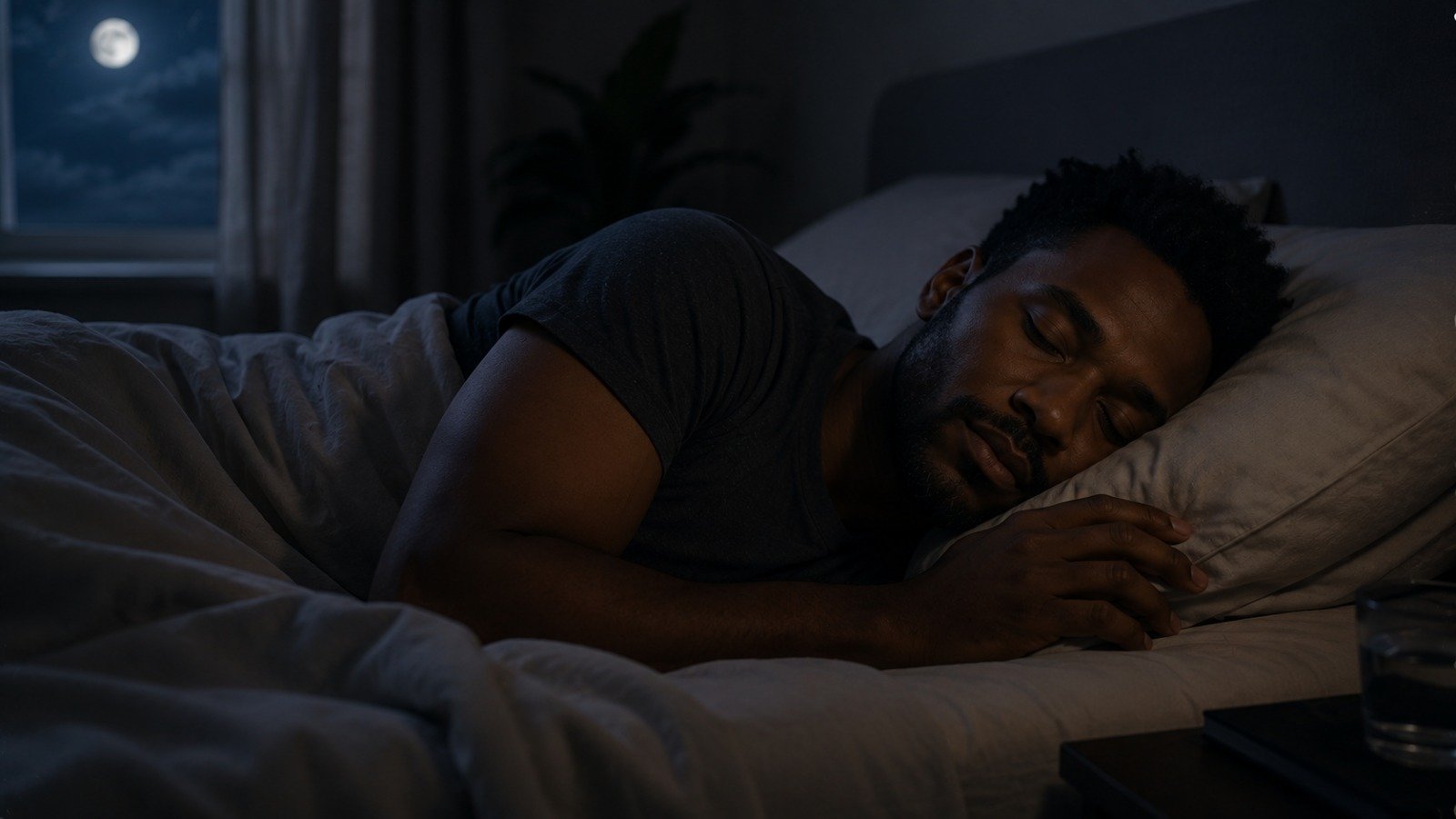
A great deal happens inside you during a night of sleep, which is why it is worth protecting. Your body spends those hours working through jobs it cannot do as well at any other time.
Your immune system, your body’s defense against illness, produces cytokines. Cytokines are tiny proteins that direct your body’s fight against infection. Think of them as the overnight dispatchers for your defense crew. They send out orders. They organize repairs. They strengthen your defenses for the next day.
A small gland at the base of your brain, the pituitary gland, sends out growth hormone in bursts, through the day and the night. Growth hormone helps you grow, helps you burn fuel, and helps keep your body in good repair. But repair is not run by one thing. Hormones, enzymes, genes and immune signals all work on it together, along with the quiet work going on inside each cell. Muscles that worked hard during the day are rebuilt. Bones are strengthened. Skin cells are renewed.
Your heart eases off, your heart rate drops, and your blood pressure usually falls to its lowest point of the day. Some people do not get that overnight dip, and doctors take note when it is missing.
Your memory is saved as well. Your brain takes the experiences of the day and turns them into long-term memories, rather like moving files out of a temporary folder into permanent storage. Sleep strengthens those memories and files them where you can find them again, so missing the sleep means learning suffers for it.
All of this happens while you lie completely still, and all of it matters. Most adults need seven hours or more for it to run properly.
Your brain does not sleep in one flat state all night. It moves through four stages, over and over, in cycles.
Think of a washing machine, where one cycle runs through soaking, washing, rinsing and spinning. Each stage does a different job, and skipping one leaves the clothes still dirty or still soaking. Sleep works the same way. A full sleep cycle often runs around 90 minutes, though it varies between people and across a single night, and most adults go through four to six complete cycles.
Light sleep
Muscles begin to relax and breathing slows. You are still easily woken, and the stage lasts only a few minutes.
Deeper light sleep
Body temperature drops a little and the heart rate slows further. Sleep spindles, short bursts of brain activity, help save memory.
Deep sleep
The largest burst of growth hormone arrives here, the immune system does its heaviest work, and blood pressure sits at its lowest. The hardest stage to be woken from.
REM
The brain becomes almost as active as when awake. Emotional memories are worked through, new connections are made, and the memory of how to do things is saved.
This is the change-over between waking and sleeping. Your muscles begin to relax and your breathing slows, and you are still easily woken. The stage lasts only a few minutes.
Your body temperature drops a little. Your heart rate slows further. Your brain begins making sleep spindles. Sleep spindles are short bursts of brain activity that help save memory. Think of them as the brain quickly organizing its files before going deeper.
This is where the heaviest physical repair happens. The largest burst of growth hormone arrives here and reaches the whole body, the immune system does its heaviest work, and blood pressure sits at its lowest. It is also the hardest stage to wake someone from. If you have ever been woken out of deep sleep you know the feeling: the confusion, the strange grogginess, the sense of being pulled back from somewhere very far away.
REM stands for rapid eye movement. During this stage your eyes move quickly beneath your closed eyelids. Your brain becomes almost as active as it is when you are awake. This is the stage where you dream most vividly.
But REM sleep is about far more than dreams. It is when emotional memories and hard experiences get worked through, and when new connections between ideas are made. The brain also practices skills and saves what is called procedural memory. That is the memory of how to do things: how to ride a bike, how to play a chord on a guitar, how to find your way along a familiar route. REM sleep strengthens all of it.
As the night goes on, the share of REM sleep in each cycle grows. That is why the last two hours of sleep matter so much for your mood and your thinking. Cutting those hours is cutting REM sleep.
Deep sleep is the stage most people cut short every night without meaning to.
Your body does not wait for night to repair itself, and building and mending run all day and all night. What sleep does is set the conditions. Growth hormone goes out at other times too, and the pattern shifts with age and health, but that first burst during deep sleep is the big one. Lose the sleep and the building slows down.
Researchers put thirteen healthy adults through two nights in an order decided by chance, one of normal sleep and one with no sleep at all. The next day they measured how fast the body was building muscle protein.
After the sleepless night that rate had fallen by 18 percent. Put another way, for every 100 units of new muscle protein their bodies built after a normal night, they built about 82 after the sleepless one. Alongside it the hormones shifted, with cortisol, your slow stress hormone, up by about a fifth and testosterone down by about a quarter.
What the study measured is the building, not the breaking down. The hormone shift points toward more breakdown, and the authors describe it that way, but that side of the ledger was not measured directly.
It was also thirteen people, and a whole night without sleep rather than a short one. Still, it puts a number on something athletes have said for years.
An athlete who sleeps poorly recovers slowly, however well she trains and eats. The work still gets done. It just gets done worse.
Your immune system is also most active during deep sleep. Sleep shapes when your body sends out cytokines and how well your defenses work. But whether you fight off a bug depends on much more than sleep. Your germ-fighting cells and proteins, your age, your health, and which germ you met all matter too.
Research in Archives of Internal Medicine put a number on it, comparing people who slept fewer than seven hours with people who slept eight or more. The short sleepers were almost three times as likely to come down with a cold. Everyone in that study was given the same virus deliberately, and how much a person slept turned out to be one of the clearest clues to who fell ill. It was not the only difference between those people, but it stood out.
If deep sleep is where the body does its heaviest work, REM is where the mind does its own.
Something strange happens to your body during REM. It goes still. Not relaxed. Held.
Your brain switches off the signals to most of your muscles, so you cannot move. Scientists call this muscle atonia, which simply means loss of muscle tone.
Picture a projector running at full speed while the chair in front of it is bolted down. The film plays. Nobody gets up and walks into it.
That is why you do not act out your dreams. It is also why some people wake up before their muscles switch back on, and find they cannot move for a few seconds. That is called sleep paralysis. It is frightening. It is also common and harmless, though tell a doctor if it happens often or comes with heavy daytime sleepiness.
REM is also where most of your vivid dreaming happens. Wake someone from REM and around eight times in ten they will report a dream.
But dreaming is not only a REM thing. Wake someone from the other stages and a smaller number still report something, though those reports tend to be more like thoughts than films: shorter, calmer, and closer to ordinary life.
One honest thing is worth saying here, and you will rarely read it elsewhere. Nobody knows why we dream. There are several theories and no settled answer.
What researchers can say with more confidence is that REM sleep seems to work on the feelings attached to your day. That might be the hard meeting, the argument, or the worry you carried around for hours. You still remember what happened. The hurt attached to it seems to fade.
That is part of why a problem that felt overwhelming at night often feels smaller by morning. Not only the passing of time. Sleep is doing something to it.
Research by the sleep scientist Matthew Walker, published in Current Biology, looked at this. During REM sleep the brain replays emotional memories while noradrenaline runs unusually low. Noradrenaline is the chemical most tied to the raw intensity of stressful moments. Playing a memory back while that chemical is low may be part of how the memory stops hurting so much. Researchers are still working out how far this goes.
Without enough REM sleep, this processing gets less time. The emotional charge of hard experiences may stay higher than it should. Worry, irritability, and quick emotional reactions all increase.

The story so far. Priya is not sleeping badly on purpose. She is sleeping the way most working adults sleep, and believing it is fine. What follows is what those missing ninety minutes are doing while she tells herself she has adjusted.
This is the important part. Sleeping too little is more than being tired. It harms almost every part of the body.
Think of a factory that never shuts for maintenance. The machines keep running and the products keep coming out, but the quality drops, breakdowns become more frequent, and parts that should last 20 years start failing at 10.
Health experts around the world find that people who sleep badly night after night carry a higher risk of several serious conditions at once: being very overweight, type 2 diabetes, heart disease, stroke, low mood, and dying younger. Type 2 diabetes is a problem with blood sugar, and a stroke happens when the blood supply to part of the brain is cut off.
That list is long for a reason. These risks rise together rather than one at a time.
The reasons are not a mystery. Too little sleep upsets the timing of cortisol, your slow stress hormone. It should rise in the morning and fall at night. Short sleep pushes that pattern out of shape. And that is only one of the ways short sleep does harm. Short sleep also changes appetite, blood sugar handling, blood pressure, and the way your immune system works. Together those push toward fat around the organs, higher blood pressure, weaker defense against illness, and poorer blood sugar control.
Poor sleep also throws off two hunger hormones. Leptin is the messenger that tells your brain you have eaten enough, and ghrelin is the messenger that tells your brain you are hungry. Think of them as the volume controls for appetite. Short sleep tends to push hunger up, and some studies find the hunger messenger rising while the fullness messenger falls, though the studies do not all agree about the hormones themselves.
One idea, two levels
The largest burst of growth hormone arrives during deep sleep. Lose the sleep and the building slows down, and the hormones shift at the same time.
Thirteen healthy adults were put through two nights in an order decided by chance, one of normal sleep and one with none. The next day, the rate at which their bodies were building muscle protein had fallen by 18 percent: about 82 units built for every 100 after a normal night. Alongside it, cortisol rose by roughly a fifth and testosterone fell by roughly a quarter. One limit is essential here. The study measured building, not breaking down. The hormone shift points toward more breakdown and the authors describe it that way, but that side of the ledger was not measured directly. It was also thirteen people, and a whole night without sleep rather than a short one.
What shows up more consistently is the outcome. People who sleep too little feel hungrier, crave richer food, and eat more the next day. Part of that is biology, and part of it is simply being awake longer, in a kitchen, with food within reach.
Poor sleep harms the brain just as much. And the harm starts fast.
A classic study in Nature put people through a hand-eye coordination task after a long stretch awake. After 17 hours without sleep they performed as badly as they did with a blood alcohol level of 0.05 percent. Legal driving limits differ from country to country, so read that as a way of measuring how much worse you get rather than as a legal line.
You are worse at what you are doing, and you do not feel worse. That is one of the most dangerous things about losing sleep, because it damages the very judgement you would need to notice the damage. The more tired you are, the less clearly you can see how tired you are.
One idea, two levels
Picture a light being dimmed very slowly, so your eyes adjust to each small drop. By the time the room is dark you have forgotten how bright it was, and nothing along the way felt like a change.
Researchers tracked people sleeping six hours a night for two weeks. By the end they scored about as badly on some thinking tests as people who had gone up to two nights with no sleep at all. They did notice feeling sleepier. What they did not notice was how far their performance had fallen. That gap is the finding, not the impairment itself: the measure people use to judge whether they are functioning is the same faculty the sleep loss has degraded, which is why so many people conclude they have adapted to six hours when the tests say otherwise.
Think of a light being dimmed very slowly, so that your eyes adjust to each small drop. By the time the room is dark you have forgotten how bright it was, and nothing along the way felt like a change.
Research published in Sleep tracked people sleeping six hours a night over two weeks. By the end, they scored about as badly on some thinking tests as people who had gone up to two nights with no sleep at all. They did notice they felt sleepier. What they did not notice was how much worse they had gotten at the tests. That gap is the dangerous part.
Long-term poor sleep also speeds the build-up of amyloid beta, the sticky protein cleared away by the overnight cleaning. Research published in the Proceedings of the National Academy of Sciences found that a single night without sleep raised the amount of amyloid beta in the human brain by enough to measure. That was twenty people, and the rise showed up in two small regions rather than across the whole brain.
The authors called it early evidence, and the distinction they draw is worth keeping. One night raises the level for a while. That is not the same as one night causing lasting build-up, and nobody has shown that it does.
The American Academy of Sleep Medicine recommends that adults sleep seven or more hours a night. Seven is the lower end of that advice, and it is genuinely enough for some people. Others do best on eight or nine. The National Sleep Foundation puts the usual range at seven to nine.
Most people have convinced themselves they can run on less, and in a sense they can, in the way that someone driving on a flat tire can still drive. The car moves. The tire is being destroyed with every mile.
A small number of people genuinely need less sleep. Research has found rare genes that let some people do well on six hours or fewer. But they are genuinely rare, and nobody knows exactly how rare. So it is worth being slow to assume you are one of them. Most people who think they have adjusted to six hours have simply stopped noticing how much worse they are working. They have gotten used to the flat tire.
The story so far. Daniel does not have better sleep genes than Priya. He has fewer things working against him at night. Most of them are ordinary, and most of them can be changed.
Your brain uses light to set its inner clock, and when your eyes detect bright light the message is simple: it is daytime, stay awake. Bright light in the evening sends that message, and screens are a common source of it. How much it matters depends on how bright the screen is, how close it sits, how long you look at it, and how sensitive you happen to be.
Light in the hour before bed can delay the release of melatonin. Melatonin is the hormone that tells your body it is time to sleep, so think of it as the sleep invitation. Screen light at night delays that invitation, you stay awake longer than your body needs, and when you do sleep the early stages are lighter and less restful.
Before your body can go into deep sleep, the temperature deep inside it has to drop a little. Think of it like a computer that needs to cool down before running its heaviest programs. A cool bedroom helps your body get there faster. Around 18 to 19 degrees Celsius, or 64 to 67 Fahrenheit, works for many adults. The World Health Organization treats 18 degrees, or 64 Fahrenheit, as the lowest safe indoor temperature in cold weather. Older people, young children, and anyone with a heart or lung problem need it warmer than that. What suits you depends on your age, your bedding, your health, and where you live.
Many people believe alcohol helps them sleep. And in one narrow sense it does. It helps them fall asleep faster. But it breaks up the sleep that follows. Alcohol cuts REM sleep in the first half of the night. It causes more waking in the second half. The result is sleep that looks like sleep from the outside but is far less restful inside. People who drink regularly before bed are cutting into the stages their body and mind need most.
Your body has an inner clock, which scientists call the circadian rhythm. It is your body’s built-in 24-hour timer, set to your usual schedule, and it prepares you for sleep and for waking at predictable times. Going to bed at a different time each night confuses that timer, rather like changing the time zone on a clock over and over, and sleep gets lighter and less restful as a result. Waking at the same time every morning, weekends included, is one of the most useful things you can do for it.
Which change helps most depends on what is actually wrong, though, and the causes are genuinely different from one another. Sleep apnea means your breathing stops over and over while you sleep. Insomnia means persistent trouble falling asleep or staying asleep. Pain, menopause, medicines, depression and shift work are each different problems again, and each of them needs its own answer.
The story so far. Priya does not need a new life to sleep like Daniel. She needs a handful of changes, and the first one costs nothing at all.
This is where to start. Waking at the same time every day anchors your inner clock. Your body learns when to expect waking and begins getting ready for sleep at the right time the night before.
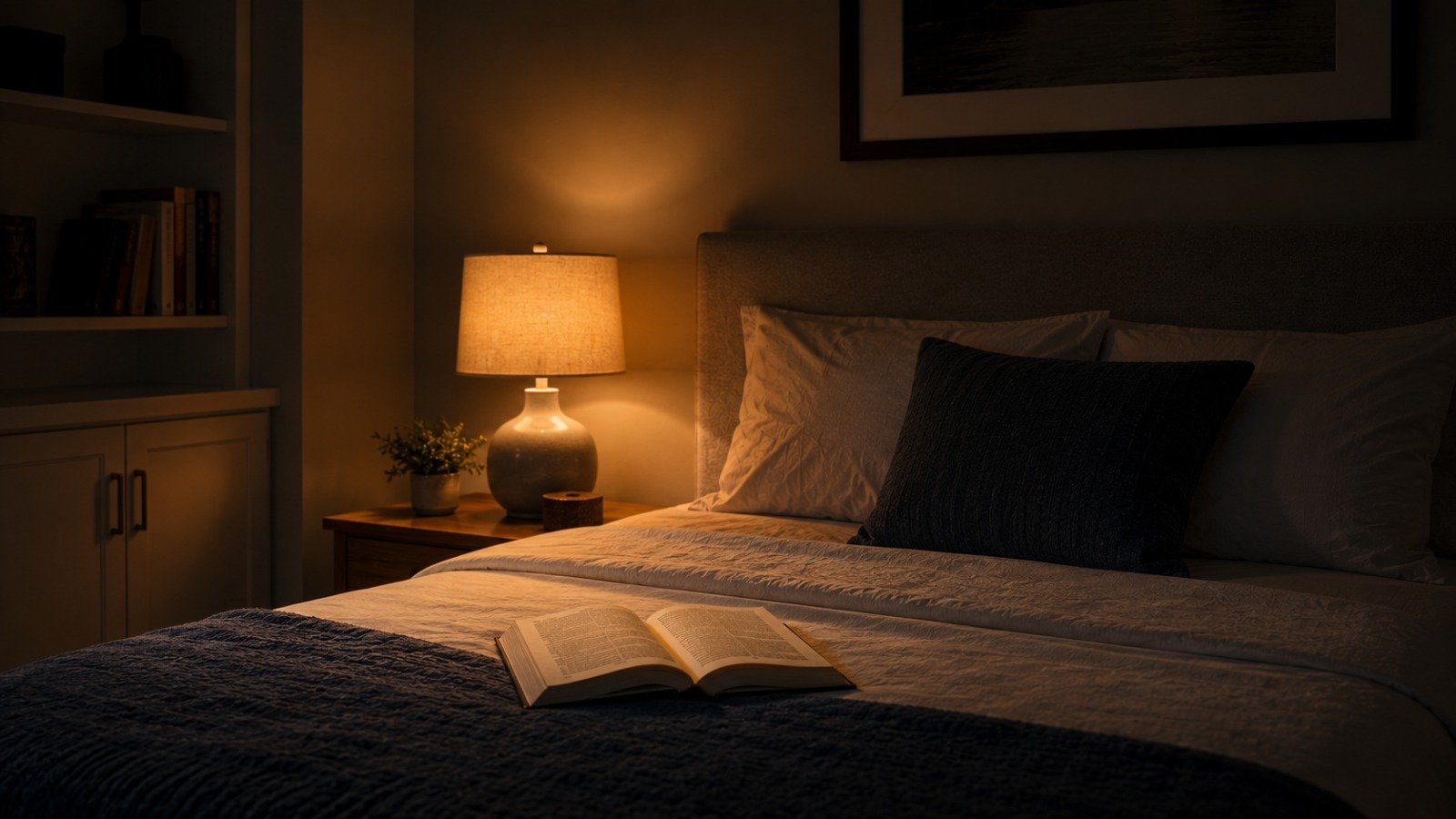
Use warm, dim lighting in the evening. Read a physical book instead of scrolling. Let melatonin rise naturally.
Cool means around 18 to 19 degrees Celsius, and not below 18. Dark means no standby lights and no street light coming through the curtains. A sleep mask is one of the cheapest useful sleep tools there is.
If you drink, drink earlier in the evening. How long your body needs to clear it depends on how much you had and on you. So leave more room than feels needed.
When it becomes clear sleep is not coming back, get up. Do not watch the clock, which only adds pressure. Go to another room. Do something calm and quiet. Return to bed when you feel sleepy. This stops your brain from linking the bed with being awake. Think of the bed as a signal. You want that signal to mean sleep. Frustration and scrolling teach it something else.
Regular movement is one of the more reliable things you can do for sleep. Adenosine is a chemical that builds up in the brain while you are awake and creates the pressure to sleep. Think of it as a sleep debt your body adds to hour by hour, and activity is part of what builds it. Regular movement helps many people sleep better, though it is not a simple dial where more exercise always buys deeper sleep.
Start here
Pick one fixed wake time and keep it every day, weekends included. Everything else on this list builds on top of it.
Never drive when you are sleepy. If you become sleepy while driving, pull over somewhere safe and stop. If possible, let someone else drive or find somewhere safe to sleep.
A short nap and caffeine may improve alertness for a little while. But the effect is temporary. They do not replace proper sleep. Do not continue driving if you still feel sleepy.
If you have nodded off while driving, or you regularly fight to stay awake at the wheel, stop driving and speak to a doctor.
See a doctor if any of these apply.
The first three can be signs of sleep apnea. The others may point to different sleep disorders. These conditions need proper assessment. A bedtime routine alone will not fix them.
Driving laws differ between countries. In the United Kingdom, you must tell the Driver and Vehicle Licensing Agency if you have certain sleep conditions that cause excessive sleepiness. You must not drive until the sleepiness is controlled. Check the rules where you live and ask your doctor if you are unsure.
Priya believes she has gotten used to six hours. That is the belief this whole article has been arguing with.
Nobody can promise her Daniel’s mornings. Sleep need differs between people, and some of what wakes her may have nothing to do with her habits.
What the evidence does say is that most people who feel they have adapted to short sleep have not. They have stopped noticing.
So the useful test is not how she feels tonight. It is how she feels after two or three weeks of going to bed thirty minutes earlier, with the same wake time.
If that changes things, she has her answer.
If it changes nothing, that is an answer too, and a more important one. Colds every few weeks and a memory that has slipped are not things to sleep off. They are things to take to a doctor.
The Main Lessons
The glymphatic system is the brain’s waste-clearing network, and it appears to work harder during sleep. Much of the early work was in mice. The NIH described this system, and a 2026 human trial found the signs in the blood you would expect if that clearing happens in people.
The American Academy of Sleep Medicine recommends seven or more hours for adults. Many adults do best between seven and nine.
People sleeping fewer than seven hours were almost three times more likely to catch a cold after exposure, according to research in Archives of Internal Medicine.
After about 17 hours awake, your reactions can be as slow as they are at a 0.05 percent blood-alcohol level. That is a way of measuring how much worse you get, not a legal limit.
Just one night without sleep measurably raises amyloid beta in the brain, according to research in the Proceedings of the National Academy of Sciences.
REM sleep works through emotional memories and softens their stress charge. Without it, worry and quick emotional reactions increase.
Poor sleep throws off ghrelin and leptin, the hunger and fullness hormones. This is why tired people eat more, and willpower has little to do with it.
Screen light delays melatonin and can make early sleep lighter. Dimming lights and screens in the hour before bed makes a real difference.
Four sleep tools sit most firmly within your control: a fixed wake time, a cool dark bedroom, no alcohol close to bedtime, and daily movement.
Golden Nugget
Sleep is the only need whose absence disables the faculty that would report it. Hunger announces itself and thirst insists, but tiredness quietly lowers the standard you were going to measure yourself against. That is why the hours have to be decided in advance rather than judged at midnight.
Waking up tired despite eight hours in bed usually means the sleep was poor in quality, not quantity. This can happen after alcohol, in a too-warm bedroom, with an irregular schedule, or when stress is high. It can also point to a sleep disorder such as sleep apnea, which breaks up deep sleep without the person knowing. If you regularly wake unrefreshed despite enough time in bed, speak to a healthcare professional.
Partly, and that partly is worth having. A long weekend sleep does make you less sleepy, and it pays back some of what you lost that week. What it does not do is undo weeks of short nights. Research suggests that after a run of short sleep, two nights of catching up do not fully repair your thinking, or the way your body handles food and blood sugar. Take the catch-up when you need it. Just do not treat it as a substitute for the ordinary week.
No. The recommended range is seven to nine hours. Most adults feel and perform best with seven and a half to eight. A small number do well on seven. A genuinely rare group have genes that let them function well on less. But most people who believe they have adapted to six hours are simply no longer noticing how impaired they are.
Set a fixed wake time and keep it every day, weekends included. This one change anchors your inner clock more powerfully than anything else. Everything else, less screen time at night, a cool dark bedroom, no alcohol close to bed, builds on top of that foundation. But the fixed wake time is where to start.
No. It gets you to sleep faster, then damages what comes after. It cuts REM sleep and causes more waking in the second half of the night, so you wake less recovered despite the hours spent in bed. Drinking regularly before bed wears sleep quality down over time.
Positively, and a lot. Regular movement raises adenosine through the day, which deepens the drive to sleep. It lowers cortisol, which makes falling asleep easier. And for many people it deepens sleep. The timing matters less than most people think. Evening exercise does not harm sleep for most people, despite common advice. If a hard session close to bedtime leaves you wired, move it earlier. The key is to be active during the day in whatever way fits your schedule.
Brief waking between sleep cycles is normal, and most people never remember it. What turns it into a problem is staying awake afterwards.
The causes are many. They include alcohol earlier in the evening, a warm room, stress or pain, sleep apnea, menopause, low mood or worry, needing the toilet, some medications, restless legs and noise. Reflux does it too, which is when stomach acid comes back up.
When sleep is clearly not coming back, get up. Keep the lights low, do something dull, and return when you feel sleepy, because lying there awake teaches your brain that bed is a place for thinking. And take it to a doctor if it happens most nights, or if it is wearing down your days. This is not one to solve alone.
Short naps help most people. Twenty to thirty minutes in the early afternoon usually lifts alertness without leaving you groggy. Though how quickly a person drops into deep sleep varies. Longer or later naps are the ones that cause trouble. They use up some of your need for sleep, so falling asleep at night gets harder. For some people, napping at all makes night-time insomnia worse. If you are already sleeping badly at night, it is worth pausing naps while you fix the nights.
They can help in the short term, and they are not a long-term answer for most people. Sleeping medicines differ a great deal from one another. And some change the shape of your sleep more than others. Several are meant for short use only. Your body can get used to them, so they work less well. And you can come to depend on them. If you are taking them already, do not stop on your own, because some cause difficult withdrawal. Talk to your doctor about a plan. For long-term insomnia, the treatment with the strongest evidence is a talking therapy designed for sleep, not a tablet.
Later than most people realize is the problem. Caffeine takes around five to six hours to fall to half its level in the body, and longer in some people. A cup at four in the afternoon can still be working at ten at night. A practical rule is nothing caffeinated after about midday if you sleep badly. And after mid-afternoon if you sleep well. The catch is that caffeine blocks the sleepiness signal without removing the tiredness underneath it.
Yes, in two ways. The light delays melatonin, and that part is well established. But the larger effect is what the phone contains. Messages, news, and video keep the mind alert at exactly the point it needs to wind down. And no night mode changes that. Charging it in another room removes both problems at once and costs nothing. If you use it as an alarm, a cheap clock solves that.
Before you go
This article is for education only. It is not medical advice and does not replace care from a qualified healthcare provider. If you regularly sleep poorly or wake unrefreshed, speak to your doctor, as it may point to a treatable sleep disorder.
Lamon S, Morabito A, Arentson-Lantz E, et al. (2021). The effect of acute sleep deprivation on skeletal muscle protein synthesis and the hormonal environment. Physiological Reports. 9(1):e14660. https://doi.org/10.14814/phy2.14660
National Institutes of Health. (2013). How Sleep Clears the Brain. https://www.nih.gov/news-events/nih-research-matters/how-sleep-clears-brain
American Academy of Sleep Medicine. (2015). Seven or More Hours of Sleep Per Night: A Health Necessity for Adults. https://aasm.org/seven-or-more-hours-of-sleep-per-night-a-health-necessity-for-adults/
Cohen S, Doyle WJ, Alper CM, Janicki-Deverts D, Turner RB. (2009). Sleep Habits and Susceptibility to the Common Cold. Archives of Internal Medicine. 169(1):62-67. https://doi.org/10.1001/archinternmed.2008.505
Van Dongen HPA, Maislin G, Mullington JM, Dinges DF. (2003). The Cumulative Cost of Additional Wakefulness: Dose-Response Effects on Neurobehavioral Functions and Sleep Physiology From Chronic Sleep Restriction and Total Sleep Deprivation. Sleep. 26(2):117-126. https://academic.oup.com/sleep/article/26/2/117/2709164
Shokri-Kojori E et al. (2018). Beta-Amyloid Accumulation in the Human Brain After One Night of Sleep Deprivation. Proceedings of the National Academy of Sciences. 115(17):4483-4488. https://doi.org/10.1073/pnas.1721694115
van der Helm E, Yao J, Dutt S, Rao V, Saletin JM, Walker MP. (2011). REM Sleep Depotentiates Amygdala Activity to Previous Emotional Experiences. Current Biology. 21(23):2029-2032. https://doi.org/10.1016/j.cub.2011.10.052
Dagum P, Elbert DL, Giovangrandi L, et al. (2026). The Glymphatic System Clears Amyloid Beta and Tau from Brain to Plasma in Humans. Nature Communications. 17:715. https://doi.org/10.1038/s41467-026-68374-8
Xie L et al. (2013). Sleep Drives Metabolite Clearance from the Adult Brain. Science. 342(6156):373-377. https://doi.org/10.1126/science.1241224
Irwin MR. (2015). Why Sleep Is Important for Health: A Psychoneuroimmunology Perspective. Annual Review of Psychology. 66:143-172. https://doi.org/10.1146/annurev-psych-010213-115205
Dawson D, Reid K. (1997). Fatigue, Alcohol and Performance Impairment. Nature. 388:235. https://doi.org/10.1038/40775
Centers for Disease Control and Prevention, National Institute for Occupational Safety and Health. (2024). Driver Fatigue on the Job. https://www.cdc.gov/niosh/motor-vehicle/driver-fatigue/index.html
National Health Service. (2026). Sleep Apnea. https://www.nhs.uk/conditions/sleep-apnoea/
Driver and Vehicle Licensing Agency. Excessive Sleepiness and Driving. https://www.gov.uk/excessive-sleepiness-and-driving
Golden Health Quest
Quest 1 of 3
This is an educational game. It does not assess your health.
Routine Builder
This is a learning game, not a personal prescription. Needs differ for shift workers, carers and people with health conditions, and some of the options below are the enemies of good sleep described earlier in this guide.
0 of 3 selected
Bedtime Calculator
This guide suggests fixing the wake time first and letting everything else follow from it. Put in the hour you need to be up and the sleep you are aiming for.
Choose both halves to work the clock backwards.
Arithmetic, not a prescription. If sleep stays poor or daytime sleepiness persists, that is a reason to seek medical advice rather than a stricter schedule.
One Realistic Step
Choose an amount of time to receive one practical step.
Choose a step that fits your circumstances. No routine guarantees a perfect night.
Was this guide useful? Share it, keep a copy or return to the evidence.