
Variety over any one food
Different plants bring different fibers, and a narrow diet feeds a narrow community.
Pillar 08 of 12
The world living inside you.
Every meal is also a delivery to a population that has lived in you since birth.
Choose how you want to read
The main lesson
A varied diet across the plant kingdom, fermented foods with live cultures, enough sleep and less ultra-processed food are what the evidence supports. Much of what is sold for gut health is not, and the popular version of the gut-brain story overstates what is actually known.
Different plants bring different fibers, and a narrow diet feeds a narrow community.
It cannot cross into the brain. The gut and brain talk, but not by that route.
IBS, IBD and reflux overlap and need different care. Cutting foods out is not a substitute for finding out.
One idea, two levels
Think of a town that lives on what comes in by road. Send a wide range of goods and every kind of trade survives. Send the same narrow load year after year and most of those trades close. Your gut microbes live like that town.
A trial in Cell put thirty-six healthy adults on either a high-fermented-food diet or a high-fiber diet for ten weeks. The fermented-food group ended with a wider mix of gut microbes and lower levels of several inflammatory markers in the blood. The other arm is the part usually left out: the high-fiber group showed neither change over the same ten weeks, which surprised the researchers, who had expected fiber to do more. Their reading was that ten weeks may be too short, and that guts in industrialized countries may lack enough of the microbes that break fiber down. It does not mean fiber fails to matter, because the evidence for fiber elsewhere is large and consistent. It means one trial found the effect in one arm and not the other, and honest reporting includes both.
An entire world lives inside your digestive system, and it is not a small one. It is vast, busy and crowded, made up of bacteria, fungi, viruses and other microbes all living together in your gut. One scientific estimate in PLOS Biology put the bacteria in a 70-kilogram reference man at about 38 trillion cells. Human cells come to roughly 30 trillion. That is close to one for one. And the number varies a great deal from person to person.
Together they are called the gut microbiome. The gut microbiome is simply the huge community of tiny living things in your digestive system. What they do is remarkable.
These tiny living things train your immune system from the day you are born. They change how much serotonin your gut lining makes, serotonin being a chemical messenger that helps run digestion. They make vitamins, though how much of that reaches the rest of you varies. They break down fiber, the part of plant food your body cannot break down alone. They help control inflammation, the body’s response to injury and infection, throughout the body. And they talk directly to your brain through a network scientists call the gut-brain axis.
Differences in the microbiome have been found in people with a wide spread of conditions, among them depression, obesity, type 2 diabetes, autoimmune disease, where the body attacks itself, and dementia, the long-term loss of memory and clear thinking. Nobody knows yet which one causes the other. Illness, medicines, diet and age all change the microbiome too.
For most of human history, nobody knew this world existed. In the last twenty years, science has uncovered it. What it found has changed the way researchers think about almost every part of health.
Your gut is not just a place where food is digested. It communicates with the immune, nervous, and metabolic systems. What you eat over months and years can help shape the microbial world inside it.
Emeka and Chioma are not real patients. They were written for this guide. Nothing that follows is a case history, a diagnosis, or a prediction about any real person.
Picture two people, Emeka and Chioma. They are both 36, live in the same city, and shop at the same supermarket.
Emeka eats mostly packaged food, which is what is in the house and what takes four minutes. He rarely eats vegetables, and could not tell you the last one he chose rather than tolerated. He takes antibiotics, medicines that kill bacteria to fight infection, whenever he gets sick, which is often, and he has never been asked whether he needed them. He is bloated after most meals. He gets an upset stomach when he travels. He feels anxious more days than not. He catches colds easily. He has been told his cholesterol is a little high. He has accepted all of it as just the way he is.
Each of those things has its own possible causes. Travel upsets stomachs for reasons that have nothing to do with the microbiome. Anxiety has many roots. Colds and cholesterol are their own stories. What we can say is narrower and still useful. A diet with almost no plants in it, and antibiotics taken when they are not needed, both change what lives in his gut.
Chioma eats a wide range of vegetables every week, not from a plan but because she shops without a list and buys whatever looks good. She eats fermented foods several times a week, a habit she picked up from her grandmother and never questioned. She takes antibiotics only when she truly needs them. She rarely has stomach trouble. She travels without stomach trouble. Her mood is usually steady. She gets ill once or twice a year at most. Her cholesterol is healthy.
Trace it back to the beginning and something becomes clear. Emeka and Chioma shop in the same aisles. They do not share genes, or how they were born, or what they were fed as babies, or the illnesses and medicines behind them. Any of that can leave a mark. What they also do not share is decades of food and daily care. And that has helped grow two different worlds inside them.
Your gut is not fixed at birth. Your diet can shift it within days, though it is only one of the things shaping it.
The gut microbiome lives mostly in your large intestine, the lower part of the gut. Scientists sometimes use the word microbiota for the tiny living things on their own. They use microbiome for those living things plus their genes and the place they live. Though people often swap the two words. Your microbiome is unique to you, like a fingerprint.
It is shaped by how you were born and whether you were breastfed, by where you grew up, and by the antibiotics you have taken. The food you eat, the stress you carry and the sleep you get all shape it too.
Think of the microbiome like a garden with many different plants. Some microbes help break down food or make useful substances. Others may do little that we understand. Some can cause trouble in the wrong place or under the wrong conditions. The same microbe may behave differently depending on the wider community and the person.
Scientists do not divide every microbe neatly into helpful and harmful groups. They study which microbes are present, what they are doing, and how stable the community is. A disrupted microbiome is sometimes called dysbiosis, but there is no single test or microbial pattern that defines it for everyone.
Greater diversity has been linked with some measures of health, but more is not always better. Scientists have not agreed on what a perfect gut mix looks like. Which kinds are there, what they do, and how steady they stay all matter too.
The American Gut Project is one of the largest gut studies ever done. It compared people by how many different plant foods they ate each week. People who said they ate more than 30 had a wider mix of gut microbes. People who said they ate 10 or fewer had less of a mix. But that plant comparison rested on small groups. About 40 people who ate more than 30 plant types were set against about the same number who ate 10 or fewer. The project as a whole was large. More than 10,000 people took part. And it watched what people ate. Nobody was assigned a diet.
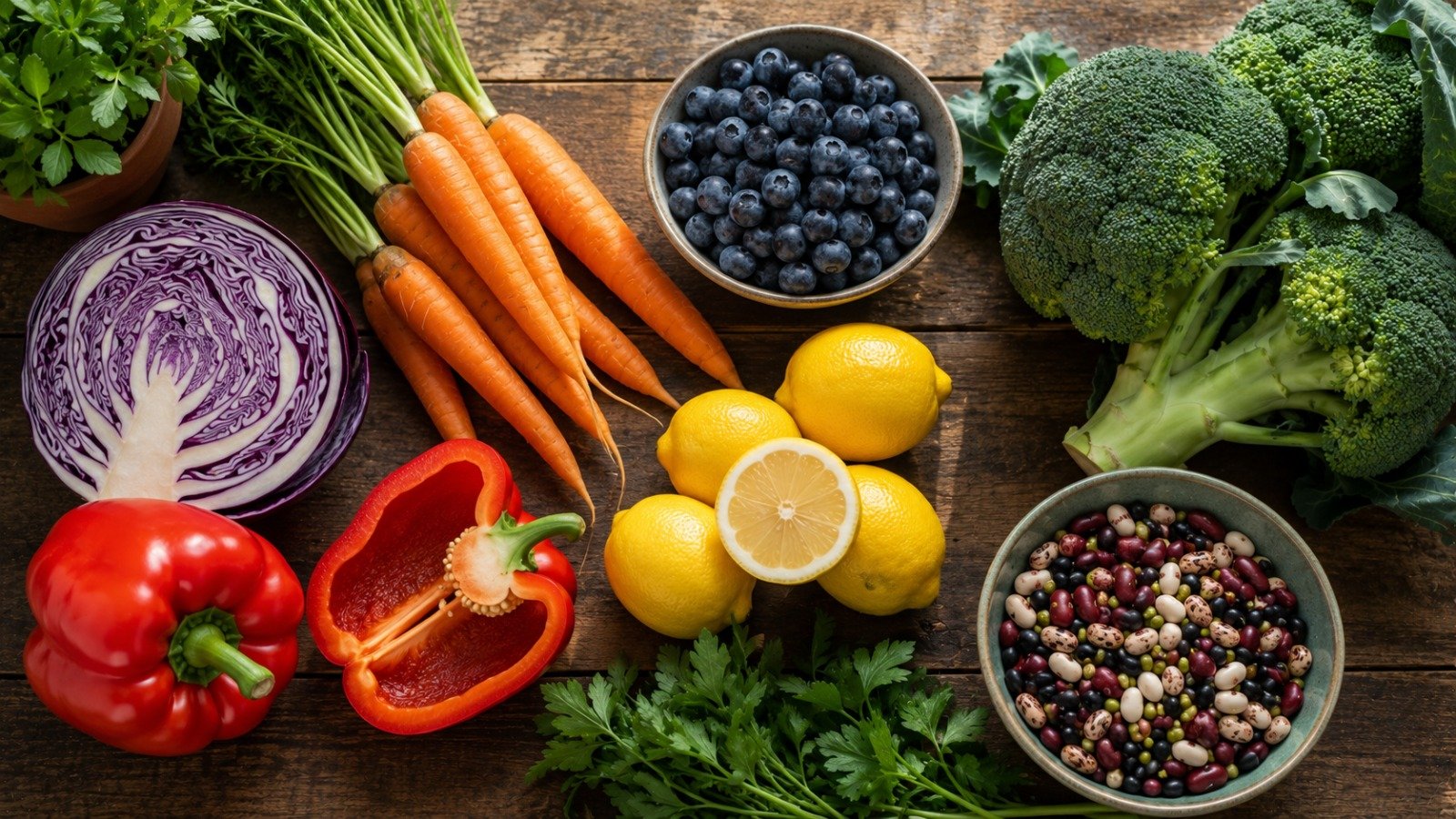
Thirty different plant foods means thirty types, not thirty portions. Different plants bring different fibers and other substances, and those can feed a wider range of microbes. Treat 30 as a good challenge rather than a target. No doctor will hold you to it, and nobody has shown that 29 is a failure.
The gut contains hundreds of millions of neurons, the nerve cells that make up the brain and the nervous system. Hundreds of millions of them line your digestive tract.
This network of nerve cells is called the enteric nervous system. It is the gut’s own built-in nervous system. Think of it as a small brain that lives in your belly. It can coordinate many parts of digestion without direct instructions from the brain in your head. But the two nervous systems still communicate and influence each other.
Have you ever felt a knot in your stomach before a hard conversation? Or felt your gut sink when you got bad news? That is not just a saying. That is your gut’s own nervous system reacting to feelings sent down from the brain.
And the messages go both ways. Think of the gut-brain axis as a highway joining two cities. Traffic flows in both directions. When something goes wrong in the gut, signals travel up this highway and affect the brain. When something goes wrong in the brain, signals travel down and affect the gut.
This is part of why worry often brings stomach trouble, and why stomach trouble often brings worry. They feed each other. They can also happen entirely separately. And they may need different treatment, so neither one explains the other away.
A large part of your body’s defense against illness sits in and around your gut. That sounds strange at first. Why would your defenses gather around your stomach and not your heart or your lungs? The answer is simple once you see it. Your gut is the one place where the outside world comes deep inside you. To your body, every meal is a stranger from outside, walking straight into the middle of you.
So think of the gut lining as a border with a guard posted along it. Everything you swallow has to pass this border. The immune cells standing guard must judge, hundreds of times a day, what is friend and what is threat. A piece of food is a friend. A harmful germ is a threat. Let the wrong thing through, and you get sick. Block the wrong thing, and your body attacks its own food.
Here is where the microbiome comes in. The helpful bacteria are the ones who train these guards, from the day you are born. They teach the guards who to wave through and who to stop. And researchers are still working out how much they shape the result. Food allergy, autoimmune disease and weak immunity are complicated. And the microbiome is one thread in each. It is not the whole explanation.
More than 90 percent of the body’s serotonin is made in the gut, not the brain. That is more than 9 parts in every 10. It comes from enterochromaffin cells, special cells in the gut lining that release chemical messengers. Research in Cell, done in mice, showed that gut microbes influence how much those cells make.
Here is what surprises people. Serotonin made in the gut cannot cross into the brain. It does its work down there, helping run digestion and the movement of the gut wall. Your brain makes its own separate supply.
So the popular version does not hold up. Feeding your gut bacteria does not lift the serotonin in your brain. The routes between gut and mood are real but less direct than that. And researchers are still mapping them. Feed the gut well, and you help those cells do their job.
One idea, two levels
More than nine parts in ten of the body’s serotonin is made in the gut. That is true. It also cannot cross into the brain, and your brain makes its own separate supply.
Gut serotonin is produced by enterochromaffin cells in the lining and acts locally, helping run digestion and the movement of the gut wall. It does not cross the blood-brain barrier, so the amount made in the gut has no direct bearing on the amount in the brain. Research in Cell, done in mice, found that gut microbes influence how much those cells produce, which is a real finding about digestion rather than about mood. The gut and brain do communicate, through the vagus nerve, through immune signals and through substances microbes make, but not by shipping serotonin upstairs.
Certain gut bacteria feed on fiber. As they do, they make substances called short-chain fatty acids. These are tiny fats the bacteria make out of fiber. One of them, butyrate, is an important fuel for the cells lining your colon.
This is the strange and wonderful part. Colon cells use butyrate as an important source of energy. Picture a chain. You eat the fiber. Certain bacteria ferment it and make short-chain fatty acids. The gut wall uses some of those substances. Diets low in fiber can change this process, though the effects differ between people and between types of fiber. Short-chain fatty acids are also being studied for their roles in immune and metabolic health.
Certain gut bacteria can make vitamin K and several B vitamins. How much of that your body absorbs and uses varies, so it does not replace getting essential nutrients from food.
When the balance of the gut microbiome tips the wrong way, the effects spread through the whole body.
The gut lining is built to be a careful filter. Think of it like a well-kept fence with small, controlled gaps. It is not a solid wall, because some things are meant to pass through. The nutrients, vitamins, and water your body needs. But the gaps are small and guarded. So the wrong things stay out: germs, half-digested food, and bacterial waste.
Now picture that fence needing repair. It is nothing so simple as a hole opening up. The mucus layer thins and the joins between the cells loosen, and what crosses the lining, along with how the immune system answers it, begins to shift.
Doctors call this increased intestinal permeability, which simply means the gut wall lets more through than it should. The proper name is worth using, because online, “leaky gut” is sold as one hidden condition behind almost any symptom. It is not that.
One idea, two levels
The gut lining is a careful filter rather than a solid wall. When it needs repair, nothing so simple as a hole opens up: the mucus layer thins, the joins between cells loosen, and what crosses begins to shift.
The measurable phenomenon is increased intestinal permeability, and it is observed in several conditions. What is not established is the popular version: that a single hidden condition called leaky gut sits behind fatigue, mood, skin and joint symptoms, and that particular supplements seal it. Permeability changes are more often a feature of a disease process than a freestanding diagnosis, and the direction of cause is frequently unclear. Using the proper name matters because it keeps the real observation separate from the marketing built on top of it.
Research published in Gut tested healthy volunteers, giving them a hormone to switch on the body’s stress response, after which the gut wall let more through. It was a small lab test, and ordinary daily stress looks nothing like it. A leakier gut wall has also been found in people with autoimmune disease, inflammatory bowel disease, obesity and mental health problems. Whether it causes those conditions or follows from them is still being sorted out.
Researchers have linked some altered microbiome patterns with changes in immune signaling and inflammation. But the direction is often unclear, because illness, medicines, diet and inflammation itself can all change the microbiome.
When you cut your finger, it may become red, warm and puffy while repair begins. That is inflammation you can see. Long-lasting low-level inflammation is a different thing, invisible and chemical, and it is associated with many chronic diseases. The microbiome may be one influence among many, but current evidence does not show that a single unhealthy gut pattern directly drives heart disease, diabetes, Alzheimer’s disease, or cancer.
The gut may reach mood along several routes: through the vagus nerve, the long nerve running from your gut up to your brainstem, through inflammation, and through tryptophan, the raw material the brain uses to build its own serotonin. Research published in Current Opinion in Psychiatry looked back over the early work here. It reported that people with depression had different gut microbes. That work only looked back at other studies. It is not proof that the microbiome causes low mood.
A varied diet and decent digestive care support your general health. They do not replace treatment for depression or anxiety. Get help from a trained professional if low mood or worry keeps going or is severe.
If you think you may harm yourself now, have taken too much medicine or another substance, are badly injured, or cannot keep yourself safe, call your local emergency number or go to the nearest emergency department now.
If there is no immediate danger, you still need support. Contact a crisis service or healthcare professional as soon as possible. Tell someone you trust what is happening.
To reach a crisis line, Find a Helpline lists verified services in more than 175 countries. The International Association for Suicide Prevention also links to crisis centers and helplines.
The gut is affected by stress and emotion, and gut signals may also influence how a person feels.
The gut-brain axis is one of the most exciting areas in modern brain science. The gut sends signals to the brain through three main channels.
The vagus nerve is the longest of the cranial nerves, the ones running straight out of the brain, and it reaches all the way down to the gut. If the gut-brain axis is a highway, this is its widest and busiest road.
Here is the part that surprises people. Most of the fibers in it carry information upward, toward the brain: around 80 percent, or about 8 lanes in every 10. They gather that information from the heart, the lungs, the gut and other organs along the way. It does not tell you how many messages actually pass in each direction, but it does say something about the design. The old idea was that the head gives the orders and the body obeys. That is not how it works. Traffic runs both ways, constantly, and the gut has a great deal to say.
The gut makes dozens of chemical messengers. Some work in the gut and pass their signal onward through the nerve. Others travel in the blood. Serotonin is one, and as we saw, the gut kind stays in the gut and helps run digestion.
In lab dishes, some gut microbes can also make GABA, the body’s calm-down signal. Whether that reaches the human brain, or changes worry, is still being studied. Nothing about it is settled. It is worth watching. It is not yet something to act on.
What is clearer is that gut and brain talk constantly, through several channels at once.
Immune cells around the gut communicate with immune systems elsewhere in the body. Researchers are studying how gut-related immune signals may influence the brain, mood, and thinking. This is a possible third route, but much of the human evidence is still developing.

The story so far. Emeka did not set out to harm his gut. He made ordinary choices that most people make without thinking. The next section names them, and none of them will surprise you.
Ultra-processed food has very little fiber in it. It has a lot of man-made additives, emulsifiers, and preservatives. Ultra-processed means food made in a factory from things you would not find in a home kitchen. Emulsifiers are additives that keep oil and water mixed in packaged food. Research published in Nature tested two of them, called carboxymethylcellulose and polysorbate-80. In mice, they upset the microbiome and drove inflammation in the gut. Only some ultra-processed products have emulsifiers in them. And these products are very different from one another. The human evidence is still building.
Many gut microbes ferment fibers that the human body cannot digest on its own. A low-fiber diet can reduce this food source and change microbial activity and composition. The result differs between people and between types of fiber.
Antibiotics are essential, life-saving medicines. But they are not precise. Think of an antibiotic as weed killer sprayed over a garden. It kills what it is aimed at, and it reaches other things too. How much depends on the drug, the dose, how long the course runs, the infection, and the person. Recovery varies just as much, and it is not always complete.
None of this is a reason to refuse antibiotics you need. They are life-saving medicines and microbiome worry is not a reason to go without them. Take them exactly as prescribed. Do not stop them, take them for longer, share them, or save them without medical advice. Your doctor may want to change the plan. Afterward, a varied diet with plenty of fiber is sensible general advice. Though no food rebuilds what was there before.
The gut-brain axis works both ways. Stress signals, including changes involving cortisol, can alter gut movement, sensitivity, and digestion. Studies also link stress with changes in the microbiome and gut permeability, but the effects are complex and differ from person to person.
Small studies have found small changes in the microbiome after a couple of nights of short sleep. Others have found little or nothing. The evidence here is early and mixed. What is clearer is that sleep and digestion affect each other. They do it in several ways that researchers are still working out.
Heavy or prolonged drinking can damage the gut lining and alter the microbiome. The effects depend on how much a person drinks, how often, nutrition, liver health, and other factors. Evidence about light drinking and the microbiome is less clear.
The story so far. Chioma is not on a special diet. She eats a wider range of plants than Emeka does. That supports overall nutrition and may also support a wider range of microbial functions.
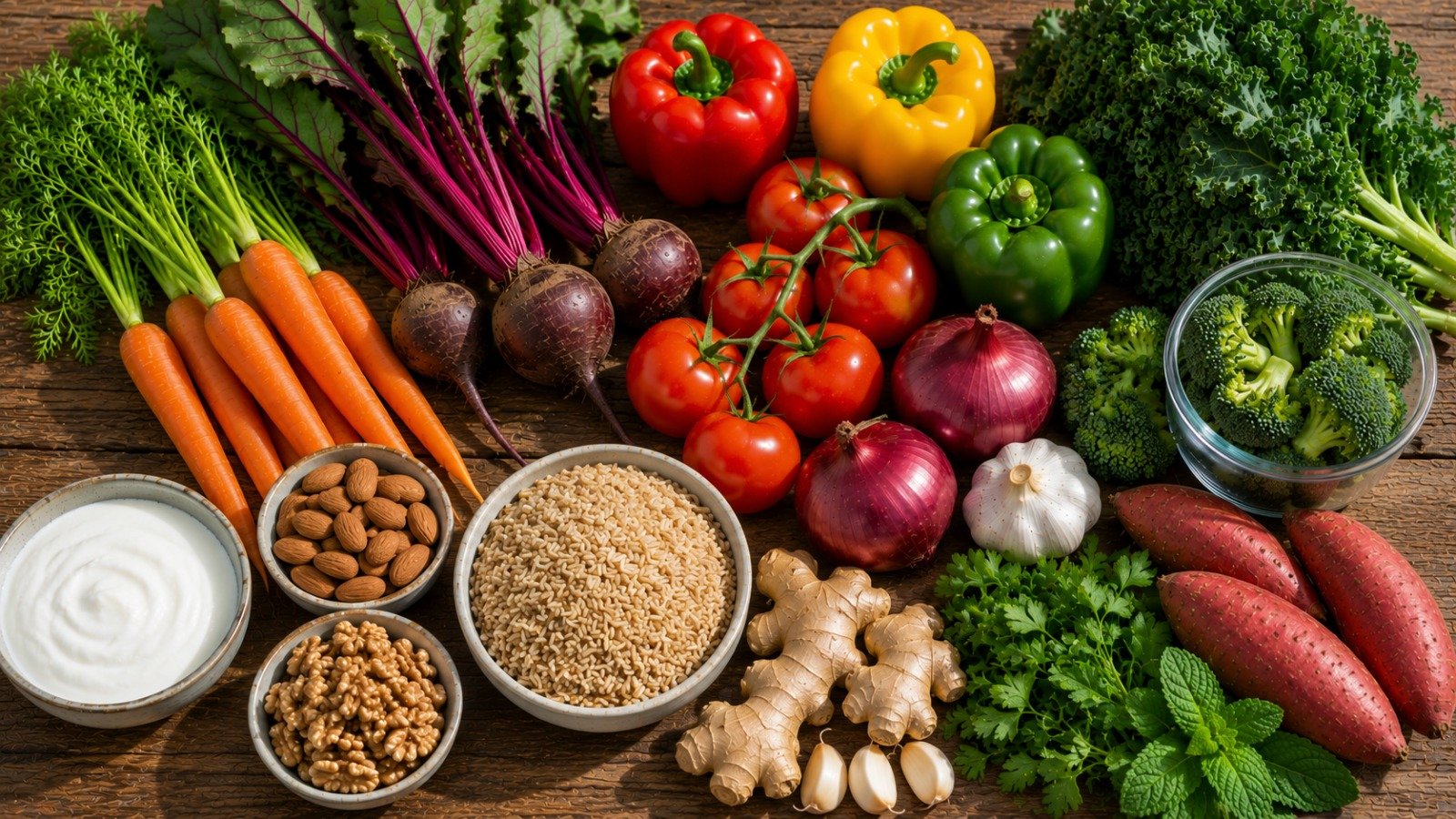
Eating many different plants is one simple way to help many kinds of microbe live in your gut. The American Gut Project asked people how many different plant foods they ate in a week. People who said more than 30 had a wider mix of gut microbes than people who said 10 or fewer. That comparison rested on small groups. Different plants hold different kinds of fiber, and different fibers support different bacteria. Vegetables, fruits, beans, whole grains, nuts, seeds, herbs, and spices all count.
Some fermented foods contain live cultures. Plain yogurt, kefir, kimchi, sauerkraut, miso and kombucha often do. Though heating, pasteurizing (heating food to kill germs), or filtering can take them out. So the label is worth a look. Those microbes tend to pass through. Few of them settle for good.
A trial in Cell compared two diets. Thirty-six healthy adults ate either a high-fermented-food diet or a high-fiber diet for ten weeks. The fermented-food group ended up with a wider mix of gut microbes, and with lower levels of several signs of inflammation in the blood.
The other half of that result is worth knowing. The high-fiber group showed neither change over the same ten weeks, which surprised the researchers, who had expected fiber to do more. Their reading was that ten weeks may be too short, and that guts in industrialized countries may lack enough of the microbes that break fiber down. It does not mean fiber fails to matter. The evidence for fiber elsewhere is large and consistent. It does mean this particular trial found the effect in one arm and not the other. It was also a small study, and it did not test doing both together.
Prebiotics are substances that certain gut microbes use in ways that may benefit health. Only some fibers meet that definition. Garlic, onions, leeks, asparagus, oats, and bananas contain fibers or starches with prebiotic effects, though amounts vary.
Replacing some ultra-processed foods with fiber-rich, minimally processed foods can improve the overall quality and variety of your diet. Not every ultra-processed food contains emulsifiers, and findings from animal studies do not automatically apply to people.
Stress can change gut movement, sensitivity, and symptoms. Tools that help you manage stress may also help some digestive symptoms.
Sleep and digestion affect each other. Though the evidence on the microbiome here is still early.
Take antibiotics only as prescribed and follow the plan your clinician gives you. Afterward, a varied, fiber-rich diet is sensible general advice, but no particular food has been proven to restore your previous microbiome.
IBS, short for irritable bowel syndrome, is one of the most common digestive conditions in the world. It brings repeated belly pain, bloating, and changes in bowel habits, either loose stools, constipation, or both. Doctors describe it as a problem in the way the gut and the brain work together. Think of IBS as a gut that has turned oversensitive. It over-reacts to things that would not trouble someone else. Stress, certain foods, and poor sleep can all set symptoms off for some people. Though none of them is the cause of IBS.
Changes to your food, ways of handling stress, and sometimes medicine all help manage it. Soluble fiber, such as the psyllium sold as a fiber powder, suits some people. Though adding fiber too fast can make gas, pain and bloating worse. That is most true for the kinds gut bacteria break down quickly. Increase it gradually. A low-FODMAP diet cuts out certain sugars that ferment fast in the gut. That diet, or any other diet that cuts foods out, works best with a dietitian guiding it. A dietitian is a trained food expert. And it should only last a while, not forever. And it needs foods brought back in one at a time. Leaving them out for good is the wrong end point. Diagnosis belongs with your doctor.
A gut turned oversensitive
Repeated belly pain, bloating and changes in bowel habits. Doctors describe it as a problem in the way the gut and the brain work together. Stress, certain foods and poor sleep can set symptoms off without being the cause.
Managed with food changes, stress handling and sometimes medicine. Diagnosis belongs with your doctor.
Inflammation that damages
Crohn’s disease and ulcerative colitis. Long-term inflammation of the digestive tract, and a different and more serious thing than IBS despite the similar name.
Needs medical diagnosis and ongoing professional care. See a doctor promptly for persistent rectal bleeding, unplanned weight loss, ongoing diarrhea, or tiredness with breathlessness.
Acid going the wrong way
Stomach acid keeps flowing back up into the esophagus, the tube connecting the mouth to the stomach.
Persistent symptoms are worth a medical conversation rather than indefinite self-treatment.
IBD includes Crohn’s disease and ulcerative colitis. These are more serious conditions involving long-term inflammation of the digestive tract, and they need medical diagnosis and ongoing professional care.
See your doctor promptly if you have any of these.
Call your local emergency number for any of these.
These can mean bleeding inside the gut. Doctors can often treat the cause. Getting help quickly matters because bleeding inside the gut can become serious.
If your stool becomes black without looking sticky or tar-like, get urgent medical advice. Some foods and medicines can darken stool, but an unexpected change still needs to be checked.
GERD stands for gastroesophageal reflux disease. It happens when stomach acid keeps flowing back up into the esophagus. The esophagus is the tube connecting the mouth to the stomach. Think of the valve between the esophagus and stomach as a trapdoor. In GERD, that trapdoor stays open when it should be shut. Acid escapes upward. Signs include heartburn, food or acid coming back up, and a sour taste in the mouth. Changes to your food help some people. So does losing extra weight, if you carry any, and staying away from the things that set your own symptoms off. Many people with GERD carry no extra weight and have no clear food triggers. And acid-suppressing medicines or other treatments may be the right answer. If symptoms come often, or do not go away, get it checked by a doctor.
The story so far. Emeka’s gut is not ruined. That is the good news. The microbiome shifts within days of eating differently. That is faster than almost any other system in the body.
Minutes, not months
Almost everything in this guide is about a gut that is uncomfortable, on a timescale of weeks. Food intolerance belongs there. Lactose intolerance is a missing enzyme rather than an immune reaction, and it causes misery rather than danger. Celiac disease is immune, but it is not this either. Food allergy is a different mechanism on a different clock, and the word a person chooses for it often decides whether they are carrying the treatment.
A man has told people for years that he has a bit of a sensitivity to shellfish. It makes his mouth itch, and he works around it. At a work dinner he eats a sauce nobody mentioned was made with it, and within ten minutes the itch has moved from his mouth to his throat. He has never been prescribed an epinephrine auto-injector, a device that gives a measured dose of epinephrine, also called adrenaline. Nobody, himself included, ever used the word allergy.
Tell a doctor if food makes your mouth or throat itch. The doctor can assess whether it may be an allergy, decide whether testing is needed, and tell you whether you need emergency medicine. If your throat swells or breathing becomes difficult, follow the emergency steps below immediately.
Anaphylaxis is a severe allergic reaction. It can quickly make breathing hard or cause a dangerous fall in blood pressure. It may happen without a rash.
What it looks like
What to do, in this order
Three things people get wrong. Carry two in-date auto-injectors, not one. Triggers are not only food and medicines: insect stings, latex and exercise all cause anaphylaxis, and in some people no trigger is ever identified. And a mild reaction in the past does not predict a mild reaction next time.
Choose a different vegetable when you shop. Add herbs and spices to your meals. Try a bean you have not eaten before. Different plants provide different fibers and nutrients.
A spoonful of plain yogurt, a small serving of kimchi or sauerkraut, or a glass of kefir all work. They are simple, cheap and easy to add.
Many health authorities recommend about 25 to 30 grams of fiber a day for adults. Most people eat far less. Whole grains, vegetables, fruits, and beans are the richest sources.
Any tool that lowers stress is also working on your gut.
Sleep and digestion affect each other.
Perfection is not the aim. Simply make it a daily default. The more whole food, the better the garden.
Start here
Add one new plant and one fermented food to what you eat today. A new vegetable and a spoonful of plain yogurt is enough to begin feeding a richer, more diverse gut.
Emeka does not need to copy Chioma’s life. And nobody can look at the two of them and prove that their microbiomes explain the difference between how they feel.
His bloating after most meals deserves a proper medical check. So does any lasting change in his bowel habits. Diet may be part of the picture. But food intolerance, irritable bowel syndrome, celiac disease, medicine side effects, and other conditions can cause similar symptoms.
What Emeka can change is smaller and more practical. He can stop using antibiotics unless a qualified healthcare professional prescribes them. He can add plant foods gradually. A bean this week. A different vegetable next week. More fiber too quickly may make bloating worse, so slow change matters.
Chioma’s habits do not guarantee a trouble-free gut. Her genes, earlier life, health conditions, medicines, and many other things still matter. What her habits give her is support, not certainty.
The useful lesson is not that one person has a good gut and the other has a bad one. It is that the garden can change. Feed it with variety. Treat symptoms seriously. Use medicines wisely. And give small changes enough time to become ordinary.
The Main Lessons
Your gut holds a vast microbial community. One estimate put the bacteria in a reference adult at about 38 trillion cells, close to the number of human cells. They play a part in how your defense against illness develops. They make some vitamins. And they break down fiber your body cannot digest alone.
In the American Gut Project, people said how many different plant foods they ate in a week. Those who said more than 30 had a wider mix of gut microbes than those who said 10 or fewer. It watched what people ate. Nobody was assigned a diet. So read 30 as a useful challenge. No doctor will hold you to it.
Almost all of the body’s serotonin is made in the gut. That is more than 90 percent, or more than 9 parts in every 10. It stays there and helps run digestion. It comes from enterochromaffin cells in the lining, not from the microbes. The gut may still reach mood, through nerve signals, through inflammation, and through tryptophan, the raw material the brain uses to make its own supply.
Current Opinion in Psychiatry looked back over early work in this area. It reported that people with depression had different gut microbes. That is not proof that one causes the other. And it does not replace treatment.
Cell reported a ten-week test with 36 healthy adults. Eating a lot of fermented food gave people a wider mix of gut microbes and lowered several signs of inflammation. The high-fiber arm of the same trial showed neither change, which the researchers thought may reflect the short timeframe. Nobody tested a diet with both.
In mice, two food emulsifiers upset the gut and drove inflammation. That is from research in Nature. Proof in people is still being gathered.
A large part of the body’s immune system sits in and around the gut. Gut microbes play a part in how it develops, and in how it is kept in balance.
Long stress, heavy drinking, antibiotics, and a diet built on ultra-processed food can all change the gut. Short sleep may too, though that evidence is early and mixed. Many different plants, fiber, fermented foods, and good sleep help it.
The gut and brain talk in both directions. They do it through the vagus nerve, through chemical messengers, and through the immune system. Each one affects the other. Neither one explains the other away.
Golden Nugget
You cannot install a gut community. You can only keep supplying one, and it becomes whatever your ordinary weeks reward. That is why no single food fixes it and why nothing you do once counts for very much.
The gut microbiome is the community of tiny living things that live mostly in the large intestine, the lower part of the gut. One estimate puts the bacteria alone at about 38 trillion cells. It includes bacteria, fungi, viruses, and other microbes. It is unique to each person. It is shaped by your genes, how you were born, breastfeeding, diet, antibiotics, stress, and sleep across your whole life. It plays a part in your defense against illness, your mood, and how your body handles energy.
Because the gut and the brain are in constant two-way contact through the gut-brain axis. When the brain senses stress, it sends signals down through the vagus nerve and through stress hormones that directly change how the gut works. Digestion slows or speeds up unpredictably. The gut gets more sensitive. The knot in the stomach is a physical response to feelings. And gut signals travel back up to the brain and can make worry stronger.
It depends on the exact microorganism, dose, and condition. A probiotic properly means a live microbe that has been shown to provide a health benefit when taken in an adequate amount. That evidence applies to the strain and use that were tested. Live microbes alone do not make a food or supplement a proven probiotic. The National Center for Complementary and Integrative Health reports that some probiotics may help prevent antibiotic-associated diarrhea in certain groups, but results vary. Ask a healthcare professional about the evidence for the product and condition you have in mind.
The microbiome can start to change within days of a real change in diet. But nobody can tell you how long a real improvement takes. A change is not always an improvement. And nobody has agreed on what a healthy microbiome looks like for everyone.
Your current habits matter. So does what came before. Early life, past antibiotics, infections, years of diet and where you have lived all leave their mark.
Occasional bloating after a big meal or certain foods is normal. Some bloating is not, and is worth a visit to your doctor: bloating that never stops, discomfort every day, or bloating that comes with pain, bleeding, or big changes in bowel habits.
Add variety. If you ate the same three vegetables this week that you ate last week, add one new one. Then another next week. Variety is what feeds a varied gut. If fermented foods appeal, add one. A spoonful of plain yogurt is an easy place to begin. Though nobody has shown that a particular amount does a particular thing.
Most people do not routinely need one. Some fermented foods contain live microbes, but they are not all proven probiotics and many contain little or no fiber. Some specific probiotic preparations may reduce antibiotic-associated diarrhea in certain groups. That is not the same as everyone needing one after antibiotics, and probiotics do not rebuild the exact microbiome that was there before. Ask a doctor first if you are severely ill, have a very weak immune system, are caring for a baby born early, or live with a complex condition.
Feed what survived. A wide range of plant foods gives the remaining bacteria the fiber they need. Fermented foods are worth eating too. Though they do not put back what was removed or recreate the microbiome you had.
How fast and how fully things recover varies by drug, dose, course length, and person. Nobody can give you a timeline. None of this is a reason to avoid antibiotics you need. It is a reason to eat well while your gut settles.
Often, yes. Irritable bowel syndrome is common and food is usually part of the picture. Though triggers differ from person to person. Some people get better by adding fiber slowly. Others get better by working out which foods set their symptoms off. A planned diet that cuts foods out can help. But it works best with a dietitian guiding it. Done alone, it tends to shrink the diet without solving anything. Any lasting change in bowel habits should be checked by a doctor first. Other conditions can look the same.
Both, and that is what makes it hard to escape. Stress measurably changes how the gut moves and how leaky its wall becomes. A disrupted gut then sends signals back that affect mood and worry. People often get stuck looking for the first cause. The useful thing is to work on both at once. Sleep, movement, and steady meals happen to help both.
Some signs need checking by a doctor, and changing your diet on your own is the wrong response to any of them.
That last one can mean anemia with no clear cause, meaning too few healthy red blood cells. It is one of the commonest signs of bowel cancer when there is no bleeding you can see.
Get emergency medical help now for any of these:
Doctors can often treat the cause. Getting help quickly matters because bleeding inside the gut can become serious.
If your stool becomes black without looking sticky or tar-like, get urgent medical advice. Some foods and medicines can darken stool, but an unexpected change still needs to be checked.
Before you go
This article is for education only. It is not medical advice and does not replace care from a qualified healthcare provider. Do you have ongoing digestive symptoms? Any bleeding, weight loss you did not plan, or severe pain? Please speak to your doctor. Your doctor can arrange the right tests for you.
McDonald D et al. (2018). American Gut: An Open Platform for Citizen Science Microbiome Research. mSystems. 3(3):e00031-18. https://doi.org/10.1128/mSystems.00031-18
Wastyk HC et al. (2021). Gut-Microbiota-Targeted Diets Modulate Human Immune Status. Cell. 184(16):4137-4153.e14. https://doi.org/10.1016/j.cell.2021.06.019
Chassaing B et al. (2015). Dietary Emulsifiers Impact the Mouse Gut Microbiota Promoting Colitis and Metabolic Syndrome. Nature. 519(7541):92-96. https://doi.org/10.1038/nature14232
Vanuytsel T, van Wanrooy S, Vanheel H, et al. (2014). Psychological Stress and Corticotropin-Releasing Hormone Increase Intestinal Permeability in Humans by a Mast Cell-Dependent Mechanism. Gut. 63(8):1293-1299. https://doi.org/10.1136/gutjnl-2013-305690
Dash S, Clarke G, Berk M, Jacka FN. (2015). The Gut Microbiome and Diet in Psychiatry: Focus on Depression. Current Opinion in Psychiatry. 28(1):1-6. https://doi.org/10.1097/YCO.0000000000000117
Cryan JF et al. (2019). The Microbiota-Gut-Brain Axis. Physiological Reviews. 99(4):1877-2013. https://doi.org/10.1152/physrev.00018.2018
World Health Organization. (2026). Healthy Diet. https://www.who.int/news-room/fact-sheets/detail/healthy-diet
Sender R, Fuchs S, Milo R. (2016). Revised Estimates for the Number of Human and Bacteria Cells in the Body. PLOS Biology. 14(8):e1002533. https://doi.org/10.1371/journal.pbio.1002533
Yano JM, Yu K, Donaldson GP, et al. (2015). Indigenous Bacteria from the Gut Microbiota Regulate Host Serotonin Biosynthesis. Cell. 161(2):264-276. https://doi.org/10.1016/j.cell.2015.02.047
National Center for Complementary and Integrative Health. Probiotics: Usefulness and Safety. https://www.nccih.nih.gov/health/probiotics-usefulness-and-safety
NHS. Vomiting Blood. https://www.nhs.uk/symptoms/vomiting-blood/
World Health Organization. (2025). Depressive Disorder (Depression). https://www.who.int/news-room/fact-sheets/detail/depression
National Health Service. Anaphylaxis. https://www.nhs.uk/conditions/anaphylaxis/
Australasian Society of Clinical Immunology and Allergy. First Aid for Anaphylaxis. https://www.allergy.org.au/hp/anaphylaxis/first-aid-for-anaphylaxis
St John Ambulance. How to Put Someone in the Recovery Position. https://www.sja.org.uk/first-aid-advice/recovery-position/
National Health Service. Stomach Ache. https://www.nhs.uk/symptoms/stomach-ache/
National Health Service. Bleeding From the Bottom. https://www.nhs.uk/symptoms/bleeding-from-the-bottom-rectal-bleeding/
National Health Service. Help for Suicidal Thoughts. https://www.nhs.uk/mental-health/feelings-symptoms-behaviours/behaviours/help-for-suicidal-thoughts/
Golden Health Quest
Quest 1 of 3
This is an educational game. It does not assess your health and it cannot diagnose a digestive condition.
Habit Builder
This is a learning game, not a personal prescription. Some of the options below are what this guide lists as disruptive rather than supportive, and anyone with a diagnosed digestive condition should follow the advice they have been given.
0 of 3 selected
Fermented Food Builder
The trial that found an effect found it in the fermented-food arm. Choose one you would genuinely eat, and a meal you genuinely have.
Choose both halves to build your addition.
A learning tool, not a prescription. If you have a diagnosed digestive condition, follow the guidance you have been given rather than this.
One Realistic Step
Choose an amount of time to receive one practical step.
If adding fiber brings on gas, pain or bloating, increase it gradually rather than pushing through.
Was this guide useful? Share it, keep a copy or return to the evidence.