
It is a picture, not a law
Harvard’s plate and the diabetes plate method differ in their details. The underlying guidance from the World Health Organization is in grams, not shares.
Golden Health Science · Article
You already know you should eat better. Almost nobody is told exactly what that means.
The plate is not a scientific law. It is a teaching tool that turns broad advice into something you can see, and it works with the food you already enjoy.
Choose how you want to read
Arrange medical assessment if you keep losing weight without trying, have difficulty or pain when swallowing, notice blood in your stool, or have abdominal pain that keeps returning, is getting worse, or regularly wakes you at night.
Get urgent medical help for black, sticky stools, bloody diarrhea, or red or dark blood mixed through your stool. Call your local emergency number for heavy or nonstop rectal bleeding, large blood clots, sudden or severe abdominal pain, fainting, confusion, difficulty breathing, or signs of shock.
Some people need advice made for them rather than a general picture: kidney disease or a fluid or potassium limit, warfarin, diabetes treated with insulin or another medicine that can cause low blood sugar, pregnancy, and a current or previous eating disorder.
The main lesson
It shows you what may be missing. Roughly half the plate vegetables or fruit, a quarter a protein food, a quarter a fiber-rich carbohydrate, and a little unsaturated fat. It is a flexible guide for main meals rather than a rule for every meal, and it adapts to budgets and food traditions rather than replacing them.
Harvard’s plate and the diabetes plate method differ in their details. The underlying guidance from the World Health Organization is in grams, not shares.
What separates oats from sweetened cereal is not that one is a carbohydrate. It is that something was taken out of the other one.
Too much salt sits near the top of the global list of diet-related risks, and it is the one an article about adding food most easily overlooks.
Two ways to read this
Official healthy eating advice is written in grams and percentages, because that is how the evidence arrives. At least 400 grams of fruit and vegetables a day. Under 5 grams of salt. Free sugars below a tenth of your energy. All of it is sound, and almost none of it survives contact with an actual kitchen at seven in the evening. The plate does one job: it converts those numbers into proportions you can see without measuring anything. You lose precision and you gain a decision you can make in the two seconds you actually have.
Dietary guidance operates at two levels that are often confused. Nutrient-based standards are expressed as intakes, and they are what the evidence base is actually built on. Food-based dietary guidelines translate those standards into foods and portions for a population, and plate models are a further translation into a visual heuristic. Each step trades precision for adherence, and each introduces assumptions: about typical plate size, about which foods count in which share, and about a mixed omnivorous diet. This is why plate models differ from one another and why none of them is authoritative in the way an intake standard is. It is also why the model breaks predictably at the edges. It cannot represent energy requirements, it says nothing about micronutrients that need specific attention in restricted diets, notably calcium, vitamin B12, iodine, iron and vitamin D, and it is not designed for anyone whose intake is being managed clinically.
You already know you should eat better. Very few know exactly what that means.
The internet is full of advice. One piece of it says the opposite of the next. Eat less carbs. No, eat less fat. Count your calories. No, forget calories and just eat good food. Never touch red meat. No, you need more protein.
It is tiring. It is confusing. And most of it misses the point.
Because eating well does not need a complicated system. You do not have to weigh every gram. You do not have to give up whole groups of food. You just need one simple idea, and to use it at every meal.
The idea is called the balanced plate. It is not a scientific law, and no single official version of it exists. It is a teaching tool, and a good one. It turns broad healthy-eating advice into something you can see on a plate.
Several versions exist. The Harvard Healthy Eating Plate and the American Diabetes Association plate method are two of the best known. They differ from each other in the details.
The version in this article is a practical blend of them. They all turn the same advice into a picture. Plenty of vegetables and fruit. Fiber-rich carbohydrate. A protein food. Unsaturated fats. Little salt, little free sugar.
This article shows you how to build one at every meal. Without a degree in nutrition. Without costly supplements. Without giving up food you love.
Chidi and Marta are not real patients. They were written for this article. Nothing that follows is a case history, a diagnosis, or a prediction about how any real person will feel after a meal.
Picture two lunches, eaten by two people, Chidi and Marta, who both think they are eating reasonably well.
Chidi has a big bowl of pasta with tomato sauce, a slice of garlic bread, and a glass of fruit juice. He has forty minutes and a microwave at work, and pasta is the thing that reheats without turning into something sad.
Marta has a piece of grilled fish with sweet potato, a big pile of leafy greens and tomatoes, and a little olive oil drizzled over the top. This is not discipline. It is most of last night’s dinner, and she cooks that way because it is what she grew up eating.
Both feel like normal lunches. Both are eaten on a normal day, by two people who have not thought about any of this since breakfast.
On average, the two meals will behave somewhat differently in the hours afterward. It is worth being clear about how much we can and cannot say.
Chidi’s lunch is mostly refined starch and juice. Little protein, little fat, and little fiber, the part of plant food your body cannot break down. A meal like that tends to send your blood glucose up faster and higher than the second one. It may not hold hunger off as long.
Marta’s has protein and vegetables. It also has unsaturated fat, the kind that stays liquid at room temperature, and the sweet potato keeps its fiber. Meals built this way are often more filling, and your glucose rise afterward is usually gentler.
What this article cannot tell you is how either of them will actually feel. People differ a great deal in how they respond to the same meal. So do the meals.
Portion sizes. Ingredients. How things were cooked. How much sleep each person had. How active they are. Any conditions or medicines. All of it changes the picture. One person may feel sleepy after the second lunch and fine after the first.
Same time of day. Same good intentions. Two meals that, on average, do somewhat different things.
Building a balanced plate is about tilting your usual meals in the second direction more often. Not every meal, and not perfectly.
The one in grams
Gives amounts, not plate shares. At least 400g of fruit and vegetables a day, salt under 5g, free sugars under a tenth of your energy. This is the layer the evidence is actually written in, and it is the layer that is hardest to use while cooking.
The one most people have seen
A picture built for the general public, with vegetables and fruit taking the largest share, whole grains and a protein food beside them, and plant oils named separately. It is a teaching tool from a school of public health, not an official national standard.
The one built for a condition
The American Diabetes Association’s version, shaped around managing blood glucose, which changes how the carbohydrate share is treated. Proof that the plate is not one fixed thing: it gets redrawn for whoever is holding it.
This article blends them. They differ in their details and they agree on the substance, which is the most useful thing to know about any plate diagram you meet: it is one translation of the guidance, not the guidance itself.
A balanced plate is not a strict rule. It is just a way of thinking about how much of each kind of food goes on your plate.
At its heart, a balanced plate brings together four things. Something that gives you protein. Lots of vegetables, in plenty of different kinds. Some carbohydrate from a whole food. A little healthy fat.
Put together, these four things give your body a lot of what it needs in one meal. Meals like this tend to fill you better than meals built mostly on refined starch. The rise in blood glucose afterward is usually smaller and slower.
Blood glucose still rises after any meal containing carbohydrate. That is normal, and it is not a crash.
The World Health Organization lists the foods to build on. Fruit and vegetables. Beans and lentils. Whole grains. Nuts. Salt, free sugars, and saturated fat stay limited.
It gives amounts, not plate shares. At least 400g of fruit and vegetables a day. Less than 5g of salt. Free sugars under 10 percent of the energy you eat. That is less than 1 calorie in every 10. Free sugars means sugar added to food and drink, plus the sugar in juice, honey, and syrup.
Saturated fat is the kind that is mostly solid at room temperature. Think of the fat in butter and fatty meat.
The balanced plate is one simple way to put that kind of advice on your table.
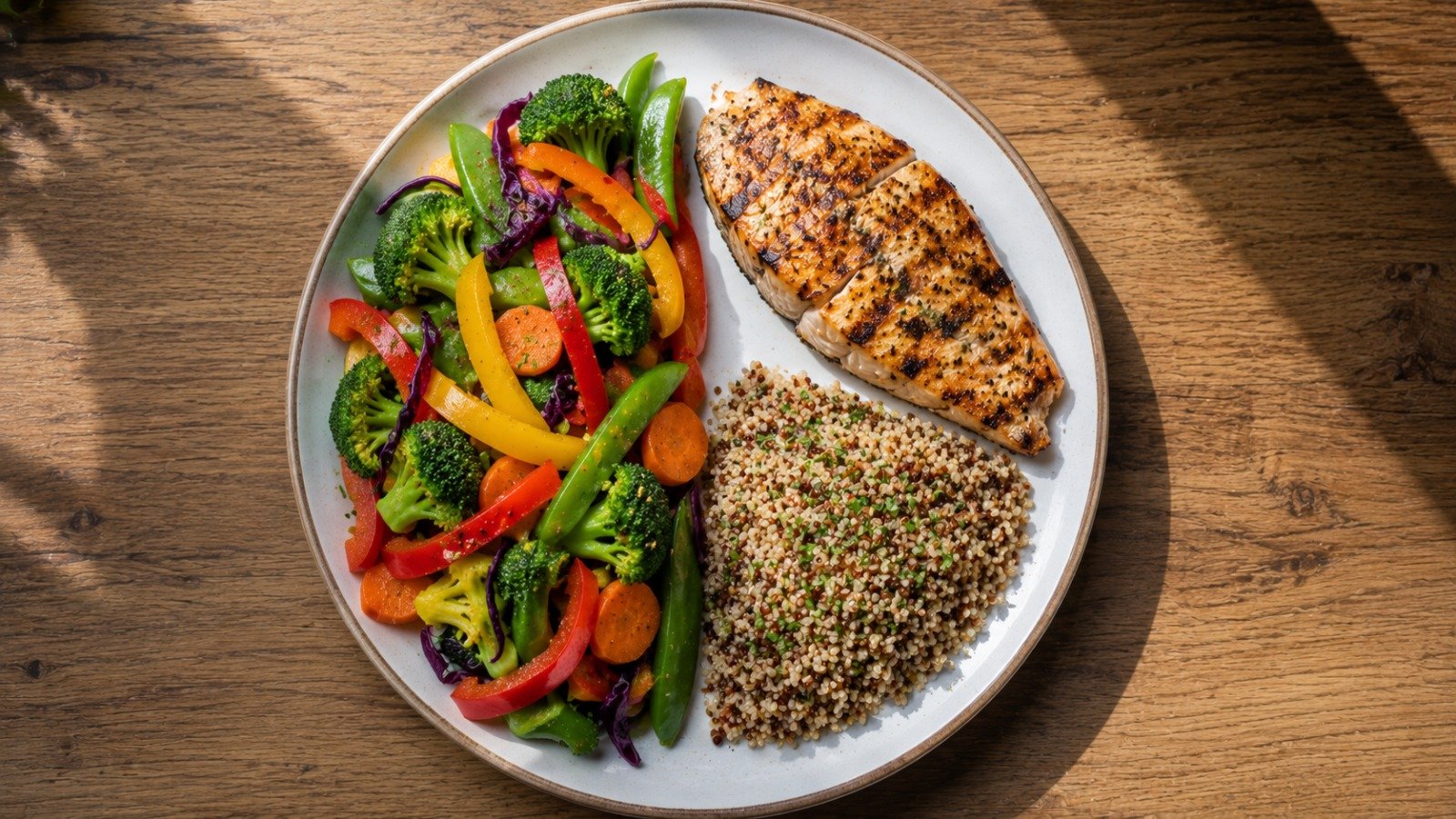
Here is the whole idea in a picture. Imagine a main meal plate split into parts.
Different colors, different kinds. Raw or cooked. Fresh or frozen. They all count. Some plate models use vegetables alone here. Others count fruit in this share too. This matters if fruit is how you most enjoy eating plants.
Eggs, chicken, fish, lean meat, plain yogurt, lentils, chickpeas, tofu, or beans. A portion about the size of your palm is a rough guide, and only that.
A palm-sized portion of tofu, beans, yogurt, or meat gives quite different amounts of protein.
Whole grains such as brown rice, whole-grain bread, oats, millet, or whole-grain cornmeal. Starchy vegetables such as sweet potato, yam, or plantain also sit here. They are not grains, but they play the same role on your plate and bring fiber with them.
Whole grain means the grain still has its bran and germ, and so keeps most of its fiber and nutrients.
Olive oil or another liquid plant oil for cooking. A little avocado. A handful of nuts or seeds. The fat from oily fish. This does not really take up room on your plate. It goes into the meal as you cook it.
That is the framework. Use it as a guide for your main meals. It is meant to be flexible. Nobody is measuring.
Where mixed dishes fit
Plenty of good food does not divide into quarters. Soups, stews, curries, sandwiches, and one-pot dishes still follow the same idea. Plenty of vegetables. A protein food. A fiber-rich carbohydrate. And some unsaturated fat, all mixed together. Beans and lentils show that the parts are not strict. They count as both protein and fiber-rich carbohydrate.
The World Cancer Research Fund looks at the studies that link certain foods to certain cancers. The strongest link is between foods with fiber, including whole grains, and a lower risk of bowel cancer.
For vegetables, fruit, and beans, the proof changes from food to food and from cancer to cancer. So this is not one finding that a plate shape stops several cancers.
This is a general guide
Some people need a different balance. That includes children, pregnant people, older adults with a small appetite, athletes, and people getting better after an illness. It also includes people with diabetes, kidney disease, digestive conditions, or eating disorders. And people who have been told by a health professional to eat less fiber. All of them should follow advice made for them by a health professional or dietitian, not this picture. The four parts also do not promise you get everything you need. Five things need extra care in some diets. They are calcium, vitamin B12, iodine, iron, and vitamin D. That is most true for vegan diets, and for diets with no dairy and no fortified substitutes. Fortified means the nutrients have been added to the food.
Protein is one important part of a balanced plate, not the most important one. A plate works because of what the parts do together. Vegetables take up the largest share of it.
Protein is one of the three big nutrients your body needs in large amounts. The three are protein, carbohydrate, and fat.
Think of a building site. Some of what arrives becomes the walls and the roof. Some becomes the tools and the workers who put it all up.
Protein supplies amino acids. Your body uses them to build and repair tissue, and to make enzymes, antibodies, and many chemical messengers. Carbohydrate and fat have important structural and energy roles too. They simply do different jobs.
Protein often helps meals feel filling. It also takes more energy to digest than carbohydrate or fat. How full you feel still depends on the amount, the food, the fiber, and the rest of the meal.
It supports muscle at every age, and getting enough helps slow the gradual muscle loss that comes with getting older. A protein food also helps make a meal filling. It may soften the glucose rise when it replaces some refined carbohydrate.
How much difference that makes depends on the whole meal, not on protein alone.
Health authorities such as the World Health Organization say to eat a mix of protein foods. Lean on beans, lentils, fish, eggs, and lean meat. And change which ones you eat through the week.
Oily fish deserve a special mention. That means fish like salmon, mackerel, sardines, and herring. They give you protein and a special kind of fat called omega-3.
Omega-3 fats are fats your body needs. One form, called ALA, is essential. That means your body cannot make it, so you must get it from food. Oily fish provide EPA and DHA. Your body can make small amounts of these from ALA, but the conversion is limited.
(Doctors call these two forms EPA and DHA. Those are just their chemical names.)
EPA and DHA have important roles in the heart, blood vessels, brain, eyes, and immune system. They can also affect inflammation. Inflammation is part of the body’s response to infection, injury, or other harm. It helps in the short term, but ongoing inflammation can contribute to disease.
The American Heart Association suggests two servings of fish a week, preferably oily fish. Advice differs by country. Pregnancy, age, and guidance on contaminants in particular fish can all change it. So check what applies where you live.
If you do not eat fish, walnuts, flaxseed, and chia give you ALA, a plant omega-3. The body converts only a small amount of ALA into EPA and DHA. So it is not a like-for-like replacement.
If you avoid fish entirely, ask a clinician or dietitian about EPA and DHA sources such as algae oil.
Most people put far too little of this on their plate.
Aim for vegetables to fill around half of a main meal plate.
Not a garnish. Not a few leaves on the side.
Why? For the calories they carry, vegetables give you more fiber, vitamins, minerals, and protective plant compounds than almost anything else.
Fiber, again, supports digestion and feeds many helpful bacteria in your gut. Some kinds can slow digestion, soften the rise in blood glucose after a meal, and help with fullness.
Those plant compounds have a name: phytonutrients. There are thousands of them. Researchers are still working out what they do in the body. It is more honest to say they are being studied than to promise what they achieve.
Different colored vegetables hold different ones. This is a good practical reason to eat a range of colors. The clearer point is simpler. Diets full of vegetables and fruit are linked to better health, study after study.
The Global Burden of Disease Study, published in The Lancet, looked at which eating habits are behind the most deaths. In 2017, three of them were behind more deaths than any others worldwide. Too much salt. Too few whole grains. Too little fruit.
Those numbers are estimates. They were worked out from data on whole populations, not by counting deaths one by one. Still, salt belongs at the top of that list. That is easy to forget in an article about what to add to your plate.
This does not mean living on salad. It just means eating enough plants at every meal to give your body what it needs. Roasted, steamed, stir-fried, or made into soups, it all works.
How you cook them can change their nutrients, texture, and added salt or fat. But the larger practical goal is to eat vegetables regularly and include different kinds.
A variety challenge worth trying
Try for 30 different plant foods across a week. Treat it as a nudge to eat more kinds of plants, not a number to hit. A wider range of plants gives you a wider range of fibers and plant compounds. Plant foods here include fruit, grains, beans, nuts, seeds, herbs, and spices, so this is easier than it sounds.
Trillions of tiny living things live in your gut. They are called microbes. Together they have a name: the microbiome.
Picture a kitchen that only ever cooks one dish. It needs one short shopping list. Now picture a kitchen cooking twenty dishes. The pantry has to be far wider.
Eating a wider range of plants stocks a wider cupboard. It gives those microbes a wider range of fibers and compounds to work with. It is also linked to a more mixed set of gut microbes.
What we cannot yet say is what that means for any one person. Scientists are studying how the microbiome links to the body’s defenses, to the way the body uses food, and to the brain. But there is no simple score for variety that tells you how healthy someone is.
And it is not true that each plant feeds its own separate family of bacteria.
The 30 figure comes from the American Gut Project. It compared two groups. One group said they ate more than 30 different plant types a week. The other said they ate 10 or fewer. The plant-rich group had more varied gut microbes.
Here is the size of that comparison. Out of more than ten thousand people in the project, the researchers looked closely at 219. Those 219 were chosen mostly from the two extremes of plant eating. The clearest comparison was about 42 people against 43. Both the chemical variety and the bacterial variety came out higher in the plant-rich group.
Two things to remember. People reported their own diets. And the study did not look at health. Thirty was a cut-off the researchers chose, not a proven target.
Carbohydrates are not bad for you. The problem is the ones that have had the good parts taken out.
This difference matters more than almost anything.
A bowl of oats and a bowl of sugary cereal are both carbohydrates. But they behave completely differently inside you.
Plain oats keep their fiber and nutrients. They are usually digested more slowly than heavily refined, sweetened cereal. For many people, the rise in blood glucose is gentler, and oats may hold hunger off for longer. The type of oats, portion, preparation, and rest of the meal still matter.
Sweetened cereal is usually made from refined grain with sugar added. So it has less fiber and is digested faster. The glucose rise afterward is usually bigger and quicker.
It then comes back down. That is the system working, not a crash.
The practical rule is simple. Make whole grains your usual choice. Brown rice instead of white. Whole-grain bread instead of white bread. Plain oats instead of sweetened cereal. Whole-grain pasta instead of the usual kind.
Usual, not always. Refined grains can fit into an otherwise good diet, and some are fortified with added nutrients. And in many food cultures the staple simply is not served in a whole-grain form.
Some people are also advised to eat less fiber for medical reasons. One useful distinction: plain instant oats are still whole grain, just cut finer so they cook and digest faster.
It is the heavily sweetened oat products that are worth watching.
Fiber is a large part of the difference.
Picture a jug of water poured through an empty funnel. It runs straight through. Now pack that same funnel with straw and pour again. All the water still gets through. It just takes longer to arrive.
Some fiber acts like the straw. It can slow digestion, soften the rise in blood glucose, feed gut microbes, and help with fullness. Different fibers behave differently. And fiber is not the only thing that matters.
How the food is structured. How finely it is milled. How it is cooked. The portion. What else is on the plate. All of it plays a part. Whole grains also carry vitamins, minerals, and plant compounds beyond their fiber.
A major review commissioned by the World Health Organization, published in The Lancet, found something striking. Higher fiber and whole-grain intake was associated with lower rates of heart disease, type 2 diabetes, and bowel cancer. The review also included trials showing benefits for several risk factors.
This is not about eating less carbohydrate. It is about choosing carbohydrate that still has its fiber in it.
One idea, two depths
Two identical jugs of water. One goes through an empty funnel and arrives all at once. The other goes through a funnel packed with straw, and every drop still arrives, just spread over a longer stretch of time. Nothing was removed from the second jug. Only the pace changed. That is roughly what happens when a carbohydrate still has its fiber and its structure, and it is why the interesting question was never how much carbohydrate a food contains, but how quickly the food lets go of it.
Several mechanisms run at once, which is why no single one explains the whole effect. The food matrix matters first: intact plant cell walls physically limit how much starch is accessible to amylase, so coarsely milled or whole grains are digested more slowly than finely milled flour of identical composition. Viscous soluble fibers, such as the beta-glucan in oats and barley, thicken the gut contents, slowing gastric emptying and the diffusion of glucose to the intestinal wall, which flattens the postprandial curve. Fermentable fibers reaching the colon are metabolized by gut bacteria into short-chain fatty acids, principally acetate, propionate and butyrate, with effects on the colonic epithelium and on metabolism that are still being characterized. Different fibers do different combinations of these things, which is why fiber grams alone predict the response poorly, and why particle size, cooking, portion and the rest of the meal all shift the result.
Fat is not something to be afraid of. The old idea that fat in food, on its own, makes people gain weight is not what the research shows. Cutting fat out is not the goal.
Even so, no nutrient is free of limits. Fat carries more energy than the others, at roughly nine calories a gram. So the amount still counts. And the type matters just as much as the amount.
Your body does need fat. Some fatty acids are essential, meaning you have to get them from food. Fat is part of the structure of every cell membrane. Fat also carries flavor and helps meals satisfy.
You will often read that fat builds hormones like testosterone and estrogen. The fuller picture is that those hormones are built from cholesterol. And that eating more fat does not simply produce more of them.
What is true is that eating too little food or fat overall can disturb hormone function. That is one reason very restrictive diets cause problems.
Some vitamins do not dissolve in water. They dissolve in fat. These are vitamins A, D, E, and K, along with plant compounds such as carotenoids.
Think of passengers waiting at a bus stop. Fat is the bus. Some passengers will walk if they must, so a few still arrive without it. Far more arrive, and arrive sooner, when the bus turns up.
Taking these vitamins in is not all or nothing, though. And many meals already have fat in them from the other foods.
That is why a little oil on your vegetables is worth having. It is doing a job there. It is not a treat to feel guilty about.
The healthiest fats come from extra virgin olive oil, avocados, nuts, seeds, and oily fish. The American Heart Association says to swap saturated fats and trans fats for unsaturated fats from plants and oily fish. Those unsaturated fats lower LDL cholesterol. LDL is short for low-density lipoprotein. It is the kind that leaves cholesterol behind in the wall of your arteries.
Trans fat is a kind of fat. The trans fat that matters most for health is the factory-made kind. It shows up in some processed and fried foods. It raises the risk of heart disease and is best avoided.
Small amounts also occur naturally in meat and dairy from animals such as cows and sheep. That is a different situation. Saturated fat, found in things like butter, fatty and processed meat, is worth keeping moderate.
Foods rich in unsaturated fat are usually the better choice. That means olive oil, avocado, nuts, and oily fish. They are better than foods high in saturated fat or factory-made trans fat. That is most true when you eat them instead of those foods. Amount, allergies, and your own health needs still apply.
One idea, two depths
If you take something off the plate, something else takes its place. That sounds obvious and it is the part the old advice left out. When people were told to eat less fat, a great deal of what filled the gap was refined starch and sugar, and the benefit that was expected did not arrive. The useful instruction is not eat less fat. It is swap this fat for that one, and it is a genuinely different sentence, because it says what goes back on the plate.
Dietary fat questions are substitution questions, and a finding is only interpretable once the replacement nutrient is specified. Controlled feeding studies show that replacing saturated fat with polyunsaturated fat lowers LDL cholesterol, with monounsaturated fat producing a smaller reduction, while replacing it with refined carbohydrate lowers LDL little if at all and tends to raise triglycerides and lower HDL. The mechanism for the LDL effect runs through hepatic LDL receptor activity, which saturated fat downregulates and polyunsaturated fat does not, reducing clearance of LDL particles from the circulation. This is the reasoning behind guidance to replace rather than simply reduce, and it is why total fat has largely been abandoned as a target. Industrially produced trans fat is the exception that needs no comparator, since it raises LDL and lowers HDL simultaneously and has no established intake below which it is beneficial.
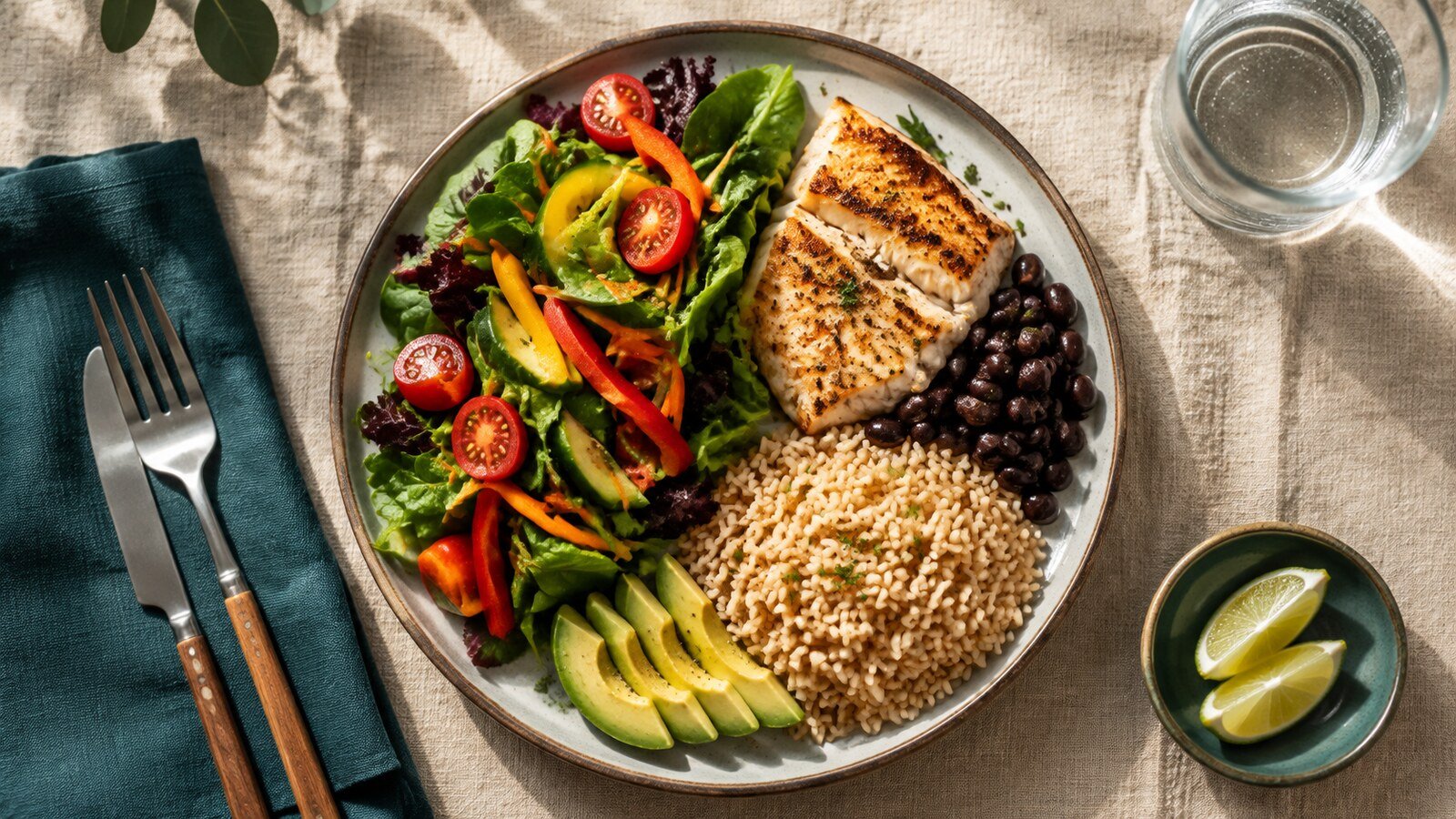
Here is what a balanced plate looks like in real life.
Half the plate: A generous heap of roasted or steamed vegetables, such as broccoli, peppers, and tomatoes.
A quarter of the plate: A palm-sized piece of fish or chicken. Or a cup of cooked lentils or beans.
A quarter of the plate: Half a sweet potato. Or a cup of brown rice, or two slices of whole-grain bread.
The fat: A drizzle of olive oil over the vegetables. Or a quarter of an avocado on the side.
That is it. No weighing, no tracking, no hard sums. The plate helps with the balance of a meal. Size is a separate question. Portions may still need adjusting for your appetite, your body, how active you are, and any health goals.
Plate size, drinks, snacks, and cooking fats all count too.
This is not a diet. It is simply a way of eating. A pattern.
The nutrition change that lasts is the one that turns into a habit. And a habit forms when you do something often enough that it becomes automatic. So start with one meal a day built this way. Then two. Then every meal.
Two eggs with a handful of greens and a few tomatoes. With a slice of whole-grain bread and half an avocado.
Or: Plain yogurt with a handful of fruit, a spoon of mixed seeds, and a little oats.
Or: Beans on whole-grain bread with sliced tomato and a squeeze of lemon.
All three give you protein, vegetables or fruit, whole grain, and healthy fat, all at once.
A big salad of mixed leaves, cucumber, onion, and tomatoes. With a tin of sardines, dressed with olive oil and lemon.
Or: Lentil soup with a chunk of whole-grain bread and a simple green salad.
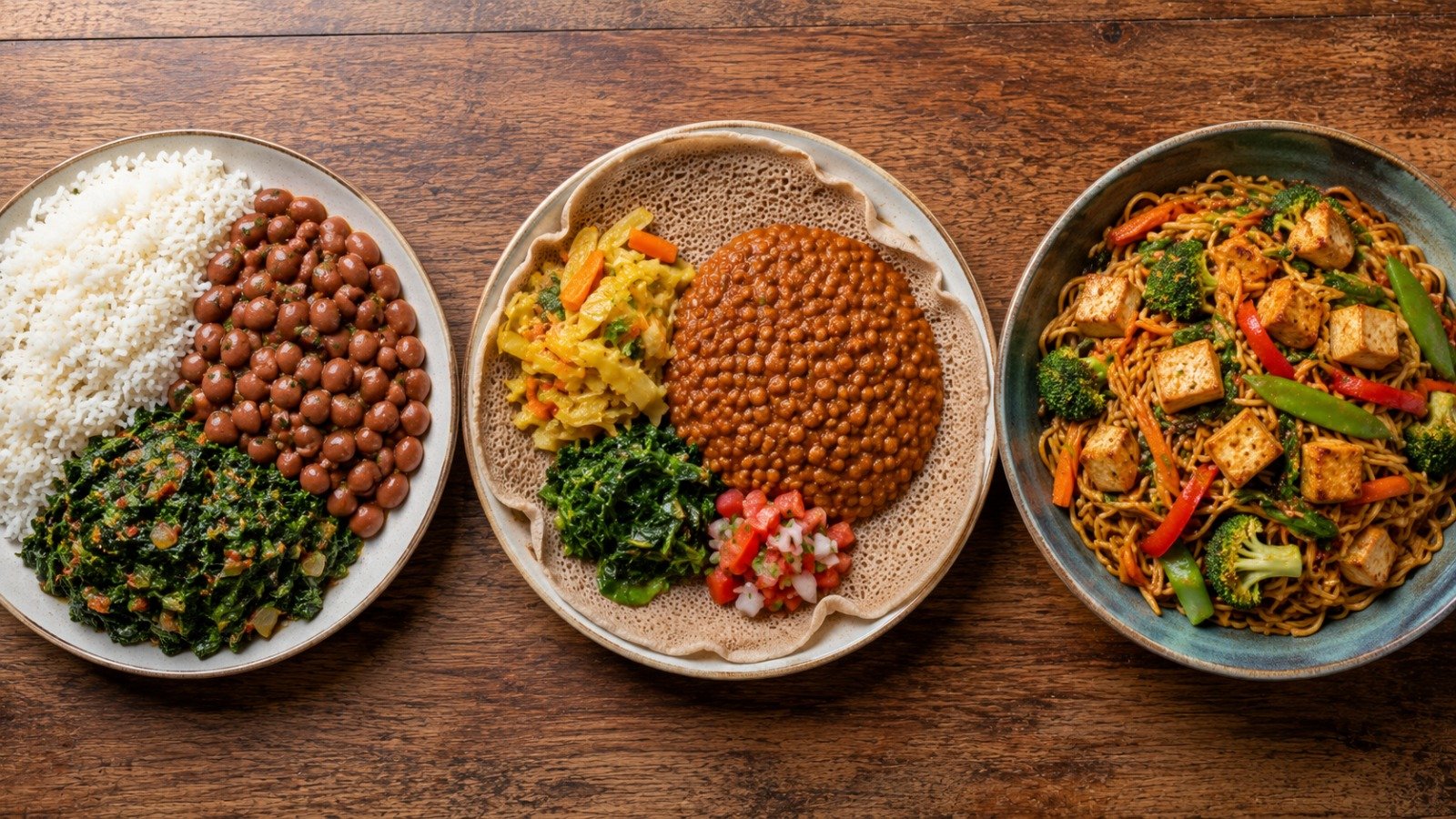
Or: Brown rice with grilled chicken, stir-fried vegetables, and a little oil.
Baked fish with sweet potato and steamed vegetables.
Or: Chickpea and vegetable stew with brown rice.
Or: Lean meat with a big helping of roasted vegetables and a green salad.
Every one of these follows the same idea. Something from each of the four parts, most of the time. Notice that the yogurt breakfast uses fruit, not vegetables. This is exactly the flexibility the plate is meant to allow.
A breakfast of refined carbohydrate alone tends to be less filling than one that includes a protein food. Adding eggs, plain yogurt, beans, or nuts may keep some people satisfied for longer.
It is worth trying. It is no rule. One breakfast does not set your blood sugar pattern for the whole day.
It is easy to build a meal with almost no protein in it, especially at breakfast and lunch. Including a protein food at main meals is a sensible habit. Spreading it across the day suits most people better than eating it all at dinner.
How much you need depends on your body size, age, activity, pregnancy, and health. And it is counted across the whole day, not meal by meal. People with kidney or liver conditions should follow advice made for them.
Vegetables are the largest part of the plate, not a decoration on the side. Aim for around half at main meals. Eating more vegetables and fruit is one of the changes with the strongest research behind it.
Some low-fat processed foods replace the fat with added sugar or starch, so they are worth checking. But plenty do not: plain low-fat yogurt and milk are simply lower in fat. For some people they are a useful way to reduce saturated fat.
Rather than assuming full-fat is always better, compare labels for added sugar, salt, and saturated fat.
Sugary drinks add free sugar and energy without doing much to fill you up. Fruit juice belongs in this group too. Though it is not identical to soda: 100 percent juice carries some vitamins and minerals.
Whole fruit is the better routine choice because the fiber is intact and it is more filling. Keep juice portions small, and make water, plain tea, or coffee your usual drink.
Salt gets missed in articles about adding good things to your plate. Yet it sits at the top of the global list of diet-related risks.
Sodium, one part of salt, helps control fluid balance. Eating too much can make the body retain more water and can raise blood pressure. Picture a hose carrying more water under pressure. The response differs greatly from person to person, and the kidneys, blood vessels, hormones, and nervous system are all involved.
Taste before you add more. Drain and rinse canned beans and vegetables where you can. Choose lower-salt versions of stock, sauces, and canned foods when they are available. Eat less of the heavily salted processed foods.
This does not mean cutting salt out. Where salt is iodized, it is also an important source of iodine.
Whole-grain versions of bread, rice, and pasta usually bring more fiber and nutrients. Make them your usual choice. When the meal in front of you is made with refined grain, no rule has been broken.
Arrange medical assessment if you keep losing weight without trying, have difficulty or pain when swallowing, notice blood in your stool, or have abdominal pain that keeps returning, is getting worse, or regularly wakes you at night.
Get urgent medical help for black, sticky stools, bloody diarrhea, or red or dark blood mixed through your stool.
Call your local emergency number for heavy or nonstop rectal bleeding, large blood clots, sudden or severe abdominal pain, fainting, confusion, difficulty breathing, or signs of shock.
Some people need advice made for them. Talk to a doctor or registered dietitian before making major dietary changes if any of these apply to you.
Go back to Chidi and Marta.
Chidi’s lunch does not need to disappear. It needs company.
Keep the pasta if that is the food he enjoys, and it still has to survive a microwave and forty minutes. Add beans, chicken, fish, or lentils. Add a generous portion of vegetables. Choose whole-grain pasta when it is available. Drink water more often than juice.
And Marta’s lunch is not perfect either, which is the half of this people forget. Its portions still matter. So do the cooking method, the amount of salt, and whatever her own body and health actually need.
That is the real lesson of the balanced plate. It does not divide food into good meals and bad meals. It shows you what may be missing.
Look at the plate in front of you. Do not ask whether it is perfect. Ask what you could add, replace, or reduce to bring its parts into better balance.
One meal will not make or break your health. But the pattern you repeat can shape it.
The Main Lessons
A balanced plate brings together plenty of vegetables or fruit, a protein food, a fiber-rich carbohydrate, and a little unsaturated fat. It is a flexible guide for main meals, not a rule for every meal.
The plate picture comes from models such as the Harvard Healthy Eating Plate and the diabetes plate method, which differ in their details. The World Health Organization gives rules and amounts, not plate shares. At least 400g of fruit and vegetables a day. Salt under 5g. Free sugars under 10 percent of the energy you eat, which is less than 1 calorie in every 10.
A protein food at main meals helps with fullness and supports muscle. Protein is one important part of the plate. It is not the most important. How much you need is judged across the day.
Aim for vegetables, or vegetables and fruit, to fill around half a main meal plate. Eating a range of colors and kinds is a practical way to get variety.
In the American Gut Project, people reporting more than 30 different plant types a week had more diverse gut microbes than those reporting 10 or fewer. It was a small comparison. People reported their own diets. It measured how varied their gut microbes were, not their health. Treat 30 as a nudge to eat more kinds of plants. It is not a target.
Whole grains keep their bran and germ, and so more of their fiber and nutrients. A Lancet review commissioned by the WHO found a link. People who eat more fiber and whole grains have lower rates of heart disease, type 2 diabetes, and bowel cancer. Make whole grains your usual choice. Treat it as a habit, not an absolute rule.
Fat is essential and should not be avoided, though amount and type both matter. Unsaturated fats from olive oil, nuts, seeds, and oily fish are usually better choices than saturated and industrial trans fats.
Sugary drinks add free sugar with little to fill you up. Whole fruit beats juice for routine use because the fiber is intact. Water is the best everyday drink.
Salt is among the leading diet-related risks worldwide. So taste before you add more. Rinse canned beans. And eat less of the heavily salted processed foods.
Some people need a different balance and should get individual advice. Children. Pregnant people. Athletes. Older adults with small appetites. People with diabetes, kidney disease, digestive conditions, or eating disorders.
The nutrition change that lasts is the one that becomes a daily habit. Start with one meal.
Golden Nugget
The plate’s real work is not telling you what to eat. It is replacing one question with a better one. Is this meal healthy has a verdict waiting at the end of it, and verdicts are why people give up: one bad answer and the whole project feels lost. What is missing from this has an answer you can act on tonight, it can be asked of any meal in any budget and any food tradition, and nobody has to be wrong first.
Pick one change and repeat it. Adding vegetables or fruit to meals you already eat is usually the easiest place to start. Including a protein food and choosing whole grains more often are the next two.
The balanced plate is based on models such as the Harvard Healthy Eating Plate and the diabetes plate method. It gives you a picture to follow instead of a set of numbers.
It translates the same advice that bodies like the World Health Organization give in grams and percentages.
There is no single number that applies to everyone. Protein needs are usually worked out across the whole day, not meal by meal. They depend on your body size, age, activity level, pregnancy, and health.
Spreading protein across meals can make it easier to meet your daily needs. It may be especially useful for older adults, although the best amount and timing are still being studied. A palm-sized portion is a rough visual guide. A palm of tofu, beans, yogurt, fish, and meat all give different amounts.
If you have kidney, liver, or metabolic conditions, or you train seriously, ask a clinician or dietitian for a figure that fits you.
Whole fruit and fruit juice are not the same thing. Juicing removes most of the fiber and leaves the sugar concentrated. Juice is usually less filling than the fruit it came from.
Even so, 100 percent juice does contain vitamins and minerals. It is not nutritionally identical to soda just because the sugar content is similar. How much it affects blood glucose depends on the juice, the amount, and what else you eat with it.
Choose whole fruit most of the time, keep juice portions small, and make water your usual drink.
Extra virgin olive oil is one of the best-studied healthy options. It is a key part of Mediterranean eating patterns, which have good research behind them for heart and blood vessel health. That does not make it the best of all oils.
Health bodies usually recommend liquid plant oils rich in unsaturated fat, and olive, canola, sunflower, and soybean oils can all fit. With the choice coming down to cooking method, availability, and cost.
Extra virgin olive oil is fine for everyday sauteing, roasting, and baking, as well as for dressings. So there is no need to reserve it for low heat only.
Yes. Frozen vegetables are usually frozen soon after picking, which preserves nutrients well. For some vitamins they can compare favorably with fresh vegetables that have traveled and been stored for days.
It depends on the nutrient, the storage time, and how you cook them. The fair summary is simple. Frozen vegetables are a nutritious, often cheaper option, and not a straight upgrade.
They are a great way to fill out your plate.
A balanced plate does not need expensive food. Though what you can afford and find differs a lot from place to place. Some foods give you the most nourishment for the money. Beans and lentils. Eggs. Frozen vegetables. Oats. Canned fish. And whatever fruit and vegetables are in season. That is if you can get them where you live.
Lentils, chickpeas, and beans give you protein, fiber, and goodness for very little money. Eggs are cheap, and they give you complete protein. That means protein with all the building blocks your body needs.
Frozen greens, peas, and broccoli can be nutritious and affordable. Compare prices where you live, and choose versions without a lot of added salt, sugar, or sauce.
Most of the time, it is the way vegetables are cooked, not the vegetables themselves. Roasting them with olive oil, garlic, and seasoning changes their taste completely, compared to boiling them.
Hiding them in soups, stews, and egg dishes makes them easier to enjoy. Start with the vegetables you mind the least, then slowly add new ones. Both the habit and the taste for them will grow.
Before you go
This article is for education only. It is not medical advice. Always speak to a qualified healthcare provider or registered dietitian before you make big changes to your diet. This matters most if you already have a health condition.
World Health Organization. Healthy Diet: Key Facts. (Fact sheet, updated periodically; accessed 2026.) who.int
GBD 2017 Diet Collaborators. (2019). Health Effects of Dietary Risks in 195 Countries. The Lancet. 393(10184):1958-1972. thelancet.com
Reynolds A et al. (2019). Carbohydrate Quality and Human Health: A Series of Systematic Reviews and Meta-Analyses (commissioned by the World Health Organization). The Lancet. 393(10170):434-445. thelancet.com
McDonald D et al. (2018). American Gut: An Open Platform for Citizen Science Microbiome Research. mSystems. 3(3):e00031-18. journals.asm.org
World Cancer Research Fund / AICR. (2018). Wholegrains, Vegetables, Fruit and Beans. wcrf.org
American Heart Association. (2023). Dietary Fats. heart.org
Estruch R et al. (2018). Primary Prevention of Cardiovascular Disease with a Mediterranean Diet. New England Journal of Medicine. 378:e34. nejm.org
Harvard T.H. Chan School of Public Health / Harvard Health Publishing. Healthy Eating Plate. health.harvard.edu
American Diabetes Association. Eating Healthy: the diabetes plate method. diabetes.org
American Heart Association. Fish and Omega-3 Fatty Acids. heart.org
National Institutes of Health, Office of Dietary Supplements. Omega-3 Fatty Acids: Fact Sheet for Health Professionals. ods.od.nih.gov
National Institute of Diabetes and Digestive and Kidney Diseases. Symptoms and Causes of Gastrointestinal Bleeding. niddk.nih.gov
National Health Service. Stomach ache. nhs.uk
Golden Health Quest
Quest 1 of 3
This is an educational game. It does not assess your diet and it is not a meal plan.
Habit Builder
This is a learning game, not a personal prescription. Some of the options below are what this article warns about rather than recommends.
0 of 3 selected
One Thing This Week
None of these is a diet. Each one changes a default, which is the only thing that survives a busy week.
Choose both halves to write your one thing.
A learning tool, not a prescription. Anything in the red box above belongs with a doctor now rather than with a plan for next week.
One Realistic Step
Choose an amount of time to receive one practical step.
Choose a step that fits your budget, what you can buy where you live, your food traditions and any condition you live with.
Was this article useful? Share it, keep a copy or return to the evidence.